https://shop.fervogear.com/cart

Ferrari’s Engine Upgrade Debut Reveals Critical Weaknesses

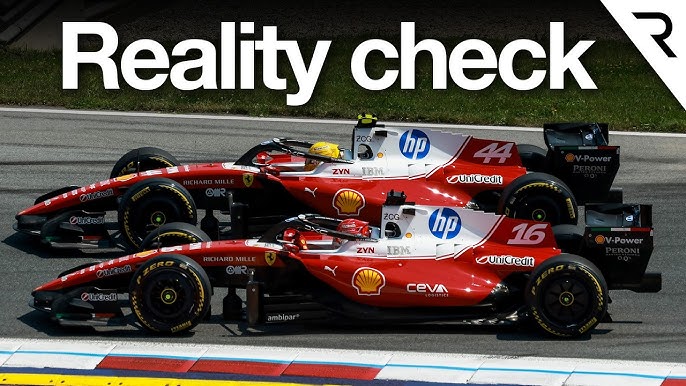
Highlights
- Ferrari debuted new engine upgrade at 2026 Austrian Grand Prix.
- Leclerc qualified second but dropped to eighth in the race.
- Ferrari’s power unit remains 4-8% behind Red Bull’s benchmark.
- Energy deployment issues caused early speed loss on main straights.
- Ferrari will focus on turbo improvements after the summer break.
- Tyre wear and strategic errors further hampered Ferrari’s race pace.
Ferrari’s upgraded power unit debuts at the Austrian Grand Prix, but the step falls short. Lewis Hamilton finishes fifth, nearly 30 seconds back, as Charles Leclerc slips from second to eighth.
The headline qualifying pace misleads. Leclerc sits two and a half tenths off George Russell, yet the Mercedes driver lifts for yellow flags after Max Verstappen’s crash.

That intervention masks Mercedes’ true margin. Kimi Antonelli’s yellow-flag error prevents a likely front-row lockout and further skews the competitive picture.
Verstappen’s early exit, caused by an RB22 malfunction, removes a key reference. It obscures the peak pace of the two fastest packages.
The core Ferrari weakness remains the power unit. Under FIA ADUO provisions, two mid-season upgrades are permitted because the ICE trails Red Bull’s benchmark by more than 4%.
The latest engine upgrade functions as intended, but the deficit likely sits between 6% and 8%. At the power-sensitive Red Bull Ring, that proves decisive.
Ferrari’s straightline deficit remains 4–8% versus Red Bull’s benchmark, despite the latest upgrade.
GPS traces show early top-end fade on the main straights. Ferrari is about 20 km/h down on Mercedes and Red Bull approaching key braking zones.
Energy deployment compounds the problem. Limited braking opportunities restrict recovery, forcing earlier harvesting and cutting decisive deployment on the straights.
Antonelli calls the deployment “weird” and nearly tangles with Leclerc at the start. Hamilton says Mercedes has “far more power,” while acknowledging Ferrari’s effort to bring an upgrade.
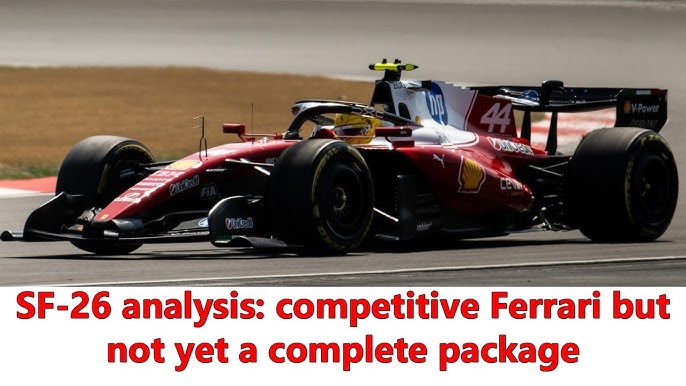
Ferrari targets its next step after the summer break, centering on turbo efficiency. A smaller turbo aids corner exit but struggles on long straights and at altitude, elevating thermal risk.
Ferrari’s next planned step focuses on turbo efficiency after the summer break.
Tyre degradation magnifies the shortcomings. Austria’s heat and rear-tyre demands force Ferrari onto a slower three-stop, while rivals manage fewer stops with less drop-off.
Leclerc reports “very, very low grip” at the rear. Enlarged cooling inlets, necessary for temperature control, likely worsen rear wear via aerodynamic penalties.
Fred Vasseur concedes the team pushes too hard early and fights Mercedes, not the real race. Hamilton asks to start on softer tyres but remains on mediums, limiting upside.
“We focused too much on Mercedes,” admits Fred Vasseur after a strategy misfire.
Barcelona’s strong showing increasingly looks circuit-specific. The Red Bull Ring exposes power and deployment limits, and Silverstone’s demands threaten to underline the same weaknesses.
Corner performance remains a strength, but straightline deficit defines the ceiling. Hopes now rest on post-break engine upgrades to close the competitive gap for 2026’s second half.
Visual Summary
▼ -20 km/h
?
?
?
Ferrari’s Engine Upgrade Falls Short
F1 power gap grows at Red Bull Ring
Tyre Wear
Rear grip vanished
Rear grip vanished
Energy Deploy
Lag on straights
Lag on straights
Cooling
Hurts aero + tyres
Hurts aero + tyres
Ferrari lost time in every department
⇣
Qualifying teased hope
(yellow flags masked rivals’ true speed)
Race day revealed reality:
Ferrari finished 4th best, trailed by 50s at the flag.
(yellow flags masked rivals’ true speed)
Race day revealed reality:
Ferrari finished 4th best, trailed by 50s at the flag.
+50 s
Leclerc’s deficit
-20 km/h
speed loss vs rivals
3
pit stops needed
6–8%
engine deficit
Next hope: TURBO UPGRADE
After summer break
After summer break
Can Ferrari fix its power and regain the grip—or does the mountain only get steeper at Silverstone?

Daniel Miller reports on Formula 1 Grand Prix weekends with race-day analysis, team-radio highlights, and point-standings updates. He explains power-unit upgrades, aerodynamic developments, and driver rivalries in straightforward, SEO-friendly language for a global F1 audience.