https://shop.fervogear.com/cart

Mercedes Uncovers Legal Hack to Bring Back Banned F1 Qualifying Trick

Highlights
- Mercedes found a legal method to revive banned qualifying trick.
- Drivers lift off throttle before timing line during flying laps.
- FIA bans continuous MGU-K power offset due to safety concerns.
- New tactic exploits rules on negative power demand to maintain max power.
- Mercedes’ drivers gained speed advantage despite slight speed drop at line.
- FIA to monitor tactic for compliance and safety in future races.
Mercedes revives a qualifying edge at Silverstone, deploying a legal throttle‑lift tactic after the FIA’s earlier ban on power offsetting. Kimi Antonelli and George Russell use it during the British Grand Prix weekend.
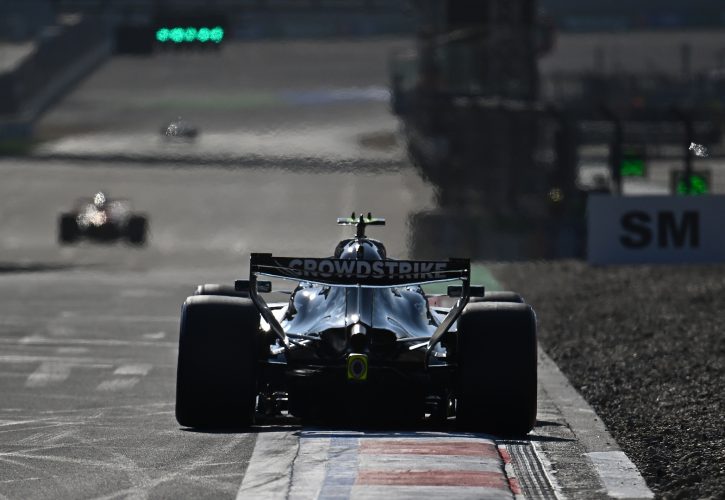
The method involves easing off just before the timing line on flying laps. That preserves maximum deployment earlier, trading a minor speed drop at the line for a net gain over the segment.

Telemetry contrasts are clear. Antonelli and Russell lift before the line, while Lewis Hamilton stays flat. Mercedes gains 7–8 km/h prior to the lift, then forfeits roughly 5 km/h crossing the line.
Earlier this season, teams exploited rules around energy deployment in qualifying. Normally, once battery energy drains, power must ramp down by 50kW each second under the regulations.
Mercedes stretched MGU‑K output to 350kW for longer, delivering a 50–100kW advantage late in laps. That approach linked to the team’s energy deployment focus and battery upgrade.
The FIA banned the continuous MGU‑K power offset in March after Japan, citing abrupt speed losses and on‑track stoppages.
Safety complaints followed. Some cars slowed severely, or even stopped, with the MGU‑K off for extended periods. The FIA outlawed the continuous offset, allowing shutdowns only for genuine emergencies.
Mercedes’ new approach differs technically. It leverages “negative driver power demand” and “negative ICE power” conditions, letting systems avoid the standard 50kW‑per‑second ramp when the driver lifts.
FIA sources confirm the throttle‑lift approach complies, provided power does not drop by more than 50kW in any one‑second window prior to the lift.
Silverstone’s short final run amplifies the benefit. Antonelli builds speed before the line from full deployment, then lifts. The exchange is positive despite the speed dip at the stripe.
Timing supports that. Antonelli trails Hamilton by around 0.125s entering the final blast, closes to 0.002s at one point, and finishes the lap 0.011s behind after the lift.
Antonelli’s final‑sector surge trims a 0.125s deficit to 0.011s, thanks to a pre‑line power push despite a small speed loss crossing the line.
Mercedes calculates that staying flat could breach the ramp‑down rules as energy tails off. The throttle‑lift keeps the car compliant while matching much of the earlier offset’s performance benefit.
Rivals watch closely. FIA officials indicate continued monitoring to ensure safety and fairness. The tactic’s effectiveness likely varies by circuit layout and final‑corner run length.
Development direction remains central. Recent comments by Toto Wolff on Mercedes upgrades underline a push to refine deployment tools within the regulations.
That dovetails with the team’s broader update pathway, including its recent upgrade direction designed to stabilise qualifying gains under tighter oversight.
Competitive pressure persists as Red Bull hunts qualifying pace. Mercedes’ precise energy management could shape strategies as the season develops and oversight intensifies.
Visual Summary
⬆️
🚀
TIMING LINE
Antonelli/Russell Full Power
Lift
Club corner
Power burst +7-8 km/h
Timing Line
Power burst +7-8 km/h
Timing Line
MERCEDES’ “LIFT-BOOST” HACK:
Legal power surge at Silverstone qualifying—by lifting off at the last second!
Legal power surge at Silverstone qualifying—by lifting off at the last second!
0.011s
Antonelli loses to Hamilton by
+7-8 km/h
extra speed on blast
50+ kW
Instant power gain
💡 Ingenious or legal loophole? Mercedes rewrites the qualifying playbook!
F1 rivals and FIA are watching closely. Will this spark another rule change?

Daniel Miller reports on Formula 1 Grand Prix weekends with race-day analysis, team-radio highlights, and point-standings updates. He explains power-unit upgrades, aerodynamic developments, and driver rivalries in straightforward, SEO-friendly language for a global F1 audience.