
https://shop.fervogear.com/cart

FIA Unveils New F1 Engine Penalty Rules for Post-2026 Era

Highlights
- FIA confirms unchanged engine penalty rules after 2026 season.
- Drivers allowed one extra power unit component without penalty.
- 2026 engine allowances increased to four ICEs and turbochargers.
- Expanded component limits kept for 2027 and 2028 seasons.
- Grid penalties apply for using components beyond allowed limits.
- Decision aims to balance performance, reliability, and development pressures.
The FIA confirms Formula 1’s engine penalty framework will remain in place after 2026, retaining the expanded component allowances introduced for that season. The clarification, shared with RacingNews365, locks in continuity.
Teams keep one additional example of each power unit component before penalties apply. That mirrors the 2026 expansion and removes uncertainty as manufacturers commit to new hardware lifecycles.

FIA locks in the 2026 penalty framework and component allowances through 2028.
Per driver, the annual limits are four ICEs, four turbochargers, three MGU-Ks, three energy stores, three control electronics, six auxiliary components, and four exhaust systems for 2026 through 2028.
Originally, allocations stood at three ICEs and turbos, two MGU-Ks, two energy stores, two control electronics, and five ancillaries. The uplift supported adaptation to the complex engine regulations set for 2026, introduced mid-cycle.
Retention beyond 2026 reflects two concerns: compressed development windows and reliability risk as technologies mature. The FIA judged a rollback would compel conservative designs and raise failure-induced grid disruption.
Penalty scale: first overuse of a component costs 10 grid places; further overuse of that type adds 5 places each time.
The penalty scale remains familiar. First use beyond the allowance for any component triggers a 10-place drop. Further overuse of that type adds five places per instance.
From 2027, the power split shifts from roughly 50:50 to about 60:40 in favour of the ICE. That rebalances stresses but does not change the agreed component ceilings.
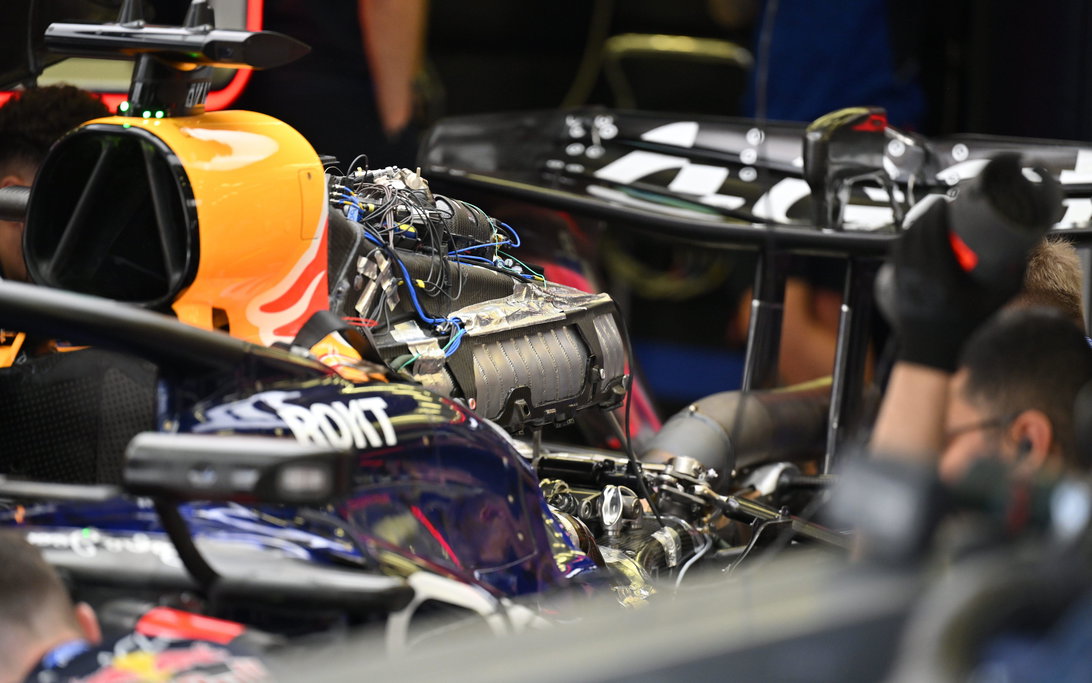
Expect teams to stage component usage against the calendar’s thermal and sprint loads. Protection against heat spikes, as seen during the Austrian GP heat, becomes central to reliability planning.
The policy also moderates competitive risk for newer manufacturers. It provides headroom to validate architectures without accepting race-ruining penalties during early-life quality escapes.
2027–2028 retain four ICEs and four turbos despite a 60:40 ICE bias in the power split.
Clear allowances simplify season planning and reduce ambiguity in sporting penalties. Combined with recent technical clarification, the framework offers stability as F1 enters a new development cycle.
Visual Summary
NO CHANGES
F1 Engine Limits
Unchanged for 2026, 2027 & 2028
Unchanged for 2026, 2027 & 2028
ICE
Turbo
MGU-K
Energy Store
PU-CE
PU-ANC
Exhaust
Exceed your allocation?
First extra part = 10-place grid drop
Engine limits locked in for the next 3 years.
Planning & reliability are king in the new F1 era.
Planning & reliability are king in the new F1 era.

Daniel Miller reports on Formula 1 Grand Prix weekends with race-day analysis, team-radio highlights, and point-standings updates. He explains power-unit upgrades, aerodynamic developments, and driver rivalries in straightforward, SEO-friendly language for a global F1 audience.