

https://shop.fervogear.com/cart


Christian Horner’s Massive Nine-Figure Red Bull Exit Payout Exposed

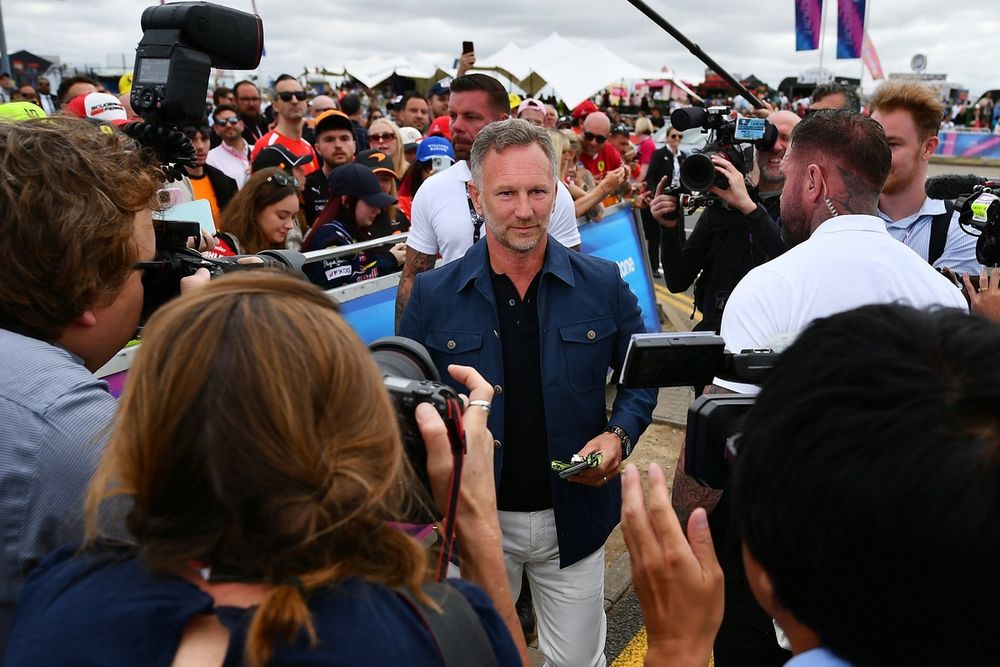
Highlights
- Christian Horner received £100.482 million payout after leaving Red Bull.
- Laurent Mekies replaced Horner as Red Bull Racing team principal.
- Horner officially left Red Bull Group on August 13, 2025.
- Horner returned to F1 paddock at 2026 British Grand Prix.
- Horner expressed willingness to return only with winning team chances.
- Mekies credited with stabilizing Red Bull’s second seat.
Company filings confirm a £100.482 million loss-of-office payment to Christian Horner following his mid-2025 exit from Red Bull. The figure reflects the scale of his influence at Milton Keynes.
The payout spans two entities. Red Bull Racing pays £33.494 million, while Red Bull Technologies contributes £66.988 million linked to his director duties and contractual protections.

Filings confirm a combined £100.482 million loss-of-office payment to Christian Horner.
Filings list August 13, 2025 as his departure from the wider Red Bull Group. Laurent Mekies takes over as team principal on July 9, 2025, ensuring continuity. Further background on Horner’s exit appears in this detailed breakdown.
Mekies prioritises stability, notably around the second seat, while maintaining development cadence and trackside execution. The transition avoids visible disruption to car programmes and operational routines.
The compensation scale matches F1’s top-tier economics and governance. Red Bull’s recent profitability provides context for severance provisions and continuity planning, as outlined in recent financial reports.
Horner returns to the paddock at the 2026 British Grand Prix, reiterating a lifelong commitment to the sport and a near-unbroken engagement with F1 since 1993.
“I’ll only return with a genuine chance of winning,” Horner says at Silverstone.
He sets a clear threshold for any comeback: only a project with realistic title prospects. That position narrows options and supports a deliberate pause before re-entering team management.
Inevitable links emerge to Alpine and Ferrari amid wider uncertainty. The Ferrari angle intensifies given recent internal pressure and driver-market churn, explored in extensive analysis.
Laurent Mekies is widely credited with stabilising Red Bull’s second seat after taking charge.
The exit structure, split across Red Bull Racing and Red Bull Technologies, illustrates modern F1 governance. Senior deals routinely blend performance clauses, non-competes, and board-level obligations.
With 2026 regulations reshaping competitiveness, timing matters. Any return hinges on technical roadmaps and resources. Red Bull’s trajectory, and a recent operational warning, frame the competitive picture.
For now, the nine-figure settlement underscores Horner’s market value and Red Bull’s confidence in its succession plan. The paddock watches for an opening that matches his win-only threshold.
Visual Summary
Exit Podium
💷
💷
💷
£100.5 MILLION
Christian Horner’s record-setting exit payout after
20 Years leading Red Bull Racing
20 Years leading Red Bull Racing
Racing
£33.5M
Tech
£67.0M
JUL ’25
Horner
exits Red Bull
exits Red Bull
SUMMER
Rumors
Ferrari? Alpine?
Ferrari? Alpine?
JUL ’26
Silverstone
Horner returns
Horner returns
“
It’s great to be back here at Silverstone.
— Christian Horner (2026 British GP)
What’s next?
All F1 is watching…
All F1 is watching…

Daniel Miller reports on Formula 1 Grand Prix weekends with race-day analysis, team-radio highlights, and point-standings updates. He explains power-unit upgrades, aerodynamic developments, and driver rivalries in straightforward, SEO-friendly language for a global F1 audience.