https://shop.fervogear.com/cart

Uncovered: Ferrari’s Game-Changing Weapon Shaking Up the Racing World

Highlights
- Ferrari introduces third power unit with ADUO upgrade in Austria
- New fuel formula by Shell enhances thermal efficiency by 2-3%
- Ferrari engine runs hotter, intake air now 114-116°C
- Mercedes faces battery temperature issues limiting current performance
- Austrian GP tests Ferrari’s upgrade against Mercedes and Red Bull
- Ferrari aims to close power gap in intense season battle
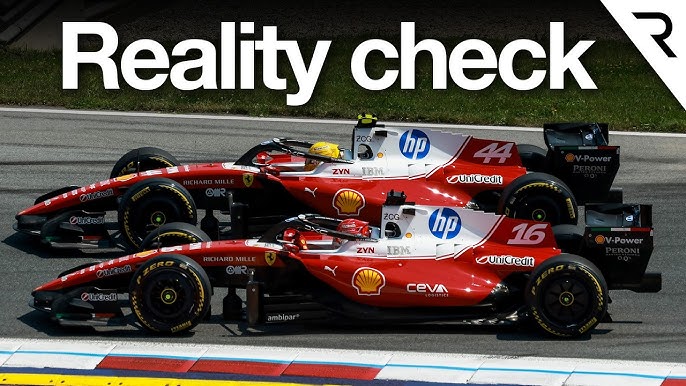
Ferrari brings its third power unit, complete with the ADUO upgrade, to the Austrian Grand Prix at Spielberg this weekend, targeting a closing of the gap to the benchmark teams.
The choice fits the circuit’s power sensitivity and a compressed four-in-five schedule, aiming to combine outright performance with improved efficiency during a pivotal title phase.
A notable design pillar remains Ferrari’s steel cylinder heads. They add weight but withstand extreme temperatures, enabling aggressive operating windows without compromising durability targets.
Ferrari debuts its third power unit with the ADUO upgrade at Spielberg.
The power unit runs hotter by intent. Intake temperatures already exceeded 100°C; the latest specification raises that window to approximately 114–116°C for Austria.
Hotter charge air lowers density yet accelerates combustion. With precise calibration, that can increase torque efficiency and reduce cycle losses despite the density trade-off.
Shell supplies a reworked fuel, its molecular structure tuned for elevated intake temperatures. The claimed thermal efficiency step sits around 2–3% under representative conditions.
Shell’s new fuel targets a 2–3% thermal efficiency gain with Ferrari’s hotter charge.
That margin can be spent as peak power or banked as a lighter fuel load, improving stint flexibility, tyre management, and race-position leverage at key phases.
Within current homologation constraints, fuel and software calibration remain potent levers. Further detail sits in the team’s recent brief on the Ferrari engine upgrade and its integration approach.
Mercedes still sets the season’s pace with six wins in seven, but battery temperature spikes have forced conservative energy deployment. Wolff recently praised Mercedes’ star for navigating those constraints.
Mercedes manages battery temperature spikes by tempering charge and deployment.
That creates a narrow opening for Ferrari on Spielberg’s short lap, where deployment timing and traction phases can amplify small combustion and ERS gains.
Austria’s layout offers an immediate A/B comparison across sprint and race trim, revealing whether Ferrari’s heat-and-fuel strategy converts to sustained competitive pace.
If the efficiency uplift holds, Ferrari can attack straights harder while protecting fuel targets, crucial for track position on a circuit with limited clean overtaking chances.
Form lines still favour Mercedes after Spain, yet Ferrari’s trajectory is upward. Any real-world step will measure against recent Mercedes changes and Red Bull’s consistency under parc fermé pressure.
[p]Austria should indicate which team carries momentum into the intense mid-season run, and whether Ferrari’s hotter philosophy unlocks the necessary headroom.[/p]
Austria offers a high-power, short-lap benchmark for Ferrari’s ADUO package.
Visual Summary
Intake Air
116°C
+2-3%
Thermal Efficiency
New Engine ?
Ferrari ADUO upgrade debuts in Austria — hotter, more efficient, and ready to fight.
Steel heads
Hotter intake
Mercedes ?
Leads the championship, but battling
battery overheating issues.
battery overheating issues.
6 wins
in 7 races
Ferrari Turns Up the HEAT
New hotter engine & fuel aim to ignite title fight in Austria.
Can Ferrari catch a struggling Mercedes in the heart of summer?
Can Ferrari catch a struggling Mercedes in the heart of summer?

James William covers the IMSA WeatherTech SportsCar Championship, from the Rolex 24 at Daytona to sprint-race formats. His reports include prototype performance reviews, GT class battles, and pit-stop strategy insights for endurance-racing fans.
Related FervoGear guide: custom race suits built for driver protection, custom fit, and sponsor-ready design.