https://shop.fervogear.com/cart

Discover How Many Power Unit Components Each Driver Has Used in 2026

Highlights
- 2026 F1 limit: up to four ICEs and Turbochargers each.
- Exceeding limits results in grid penalties starting with 10 places.
- Oscar Piastri used two ICEs; Lando Norris at three ES and CEs.
- Max Verstappen conservatively uses two ICEs; Hadjar maxed at four.
- Alonso exceeded limits with four CEs, ESs and six PU-ANCs used.
- 2027 regulations will tighten component limits further for all drivers.
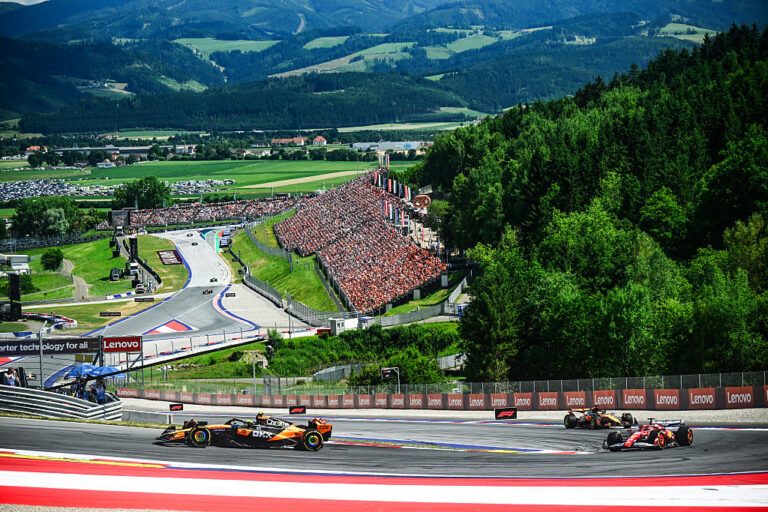
Round eight in Austria frames the season’s first real reliability audit, as power unit component usage increasingly dictates strategy, qualifying prospects, and penalties.
F1 power units comprise ICE, MGU-K, turbocharger, energy store, control electronics, and exhaust.

For 2026, allocations are four ICEs and turbochargers, three MGU-Ks, energy stores and control electronics, plus four exhausts, under updated FIA power unit regulations.
A new “bonus” allowance grants one extra component this year, before 2027 tightens limits further.
Penalties escalate quickly: the first breach triggers a 10-place drop; subsequent breaches are five places. Exceed 15 combined and the driver starts from the back.
First breach: 10-place grid drop. Further breaches: five places. Over 15 total: start from the back.
McLaren split their load: Oscar Piastri sits on two ICEs and turbochargers, while Lando Norris has reached three energy stores and control electronics.
Mercedes run aggressively. George Russell and Kimi Antonelli each sit on three ICEs and turbochargers, with Russell leading ancillary usage at five PU-ANC.
Red Bull balance performance and headroom. Max Verstappen remains at two ICEs and turbochargers, while Isack Hadjar has already maxed out with four of each.
Verstappen holds two ICEs and turbochargers; Hadjar has already peaked at four.
Ferrari’s picture is mixed. Charles Leclerc and Lewis Hamilton are on three ICEs and turbochargers, with Hamilton slightly higher across energy stores and other elements.
Recent Ferrari engine updates chase improved durability amid mounting mileage and cooling demands.
Aston Martin face sharper attrition. Lance Stroll edges toward several limits, while Fernando Alonso has hit four control electronics and energy stores, plus six PU-ANC, indicating sustained reliability strain.
Alonso’s tally: four CEs, four ESs, and six PU-ANC underline heavy reliability load.
Alpine keep powder dry. Pierre Gasly and Franco Colapinto remain on two ICEs and turbochargers, preserving penalty flexibility into the summer run.
Williams track conservatively. Alex Albon stays below thresholds, and Carlos Sainz uses even fewer components, retaining tactical freedom for high-downforce rounds.
Audi’s programme adds intrigue. Nico Hülkenberg sits on three ICEs and turbochargers, with Gabriel Bortoleto at two, as debates over FIA-Audi engine rulings cloud development clarity.
Haas maintain restraint. Esteban Ocon and Ollie Bearman keep component usage low, protecting strategic options if reliability shocks surface.
Technical directives, including recent Ferrari-related bans, complicate upgrade paths and cooling solutions that influence reliability envelopes.
With penalties looming and 2027 caps tightening, teams must balance outright performance with robust mileage planning across Europe and beyond.
Visual Summary
ICE
TC
MGU-K
ES
CE
EX
TC
MGU-K
ES
CE
EX
4 allowed
4 allowed
3 allowed
3 allowed
3 allowed
4 allowed
4 allowed
3 allowed
3 allowed
3 allowed
4 allowed
?️
?
?️
?️
⬇️
Penalty = Grid Drop
10 Places (first time)
5 Places (next)
15+ drops: Back of grid!
10 Places (first time)
5 Places (next)
15+ drops: Back of grid!
Piastri
McLaren
McLaren
2x ICE/TC
Low Usage
Low Usage
Norris
McLaren
McLaren
3x ES/CE
Getting High
Getting High
Russell
Mercedes
Mercedes
3x ICE/TC, 5x PU-ANC
On Limit
On Limit
Alonso
Aston Martin
Aston Martin
4x CE/ES
Exceeding!
Exceeding!
Verstappen
Red Bull
Red Bull
2x ICE/TC
Managing Well
Managing Well
Sainz
Williams
Williams
Lowest Usage
⚡ Power unit management now decides who belongs at the front, and who drops to the back.

Daniel Miller reports on Formula 1 Grand Prix weekends with race-day analysis, team-radio highlights, and point-standings updates. He explains power-unit upgrades, aerodynamic developments, and driver rivalries in straightforward, SEO-friendly language for a global F1 audience.
Related FervoGear guide: custom race suits built for driver protection, custom fit, and sponsor-ready design.