
https://shop.fervogear.com/cart

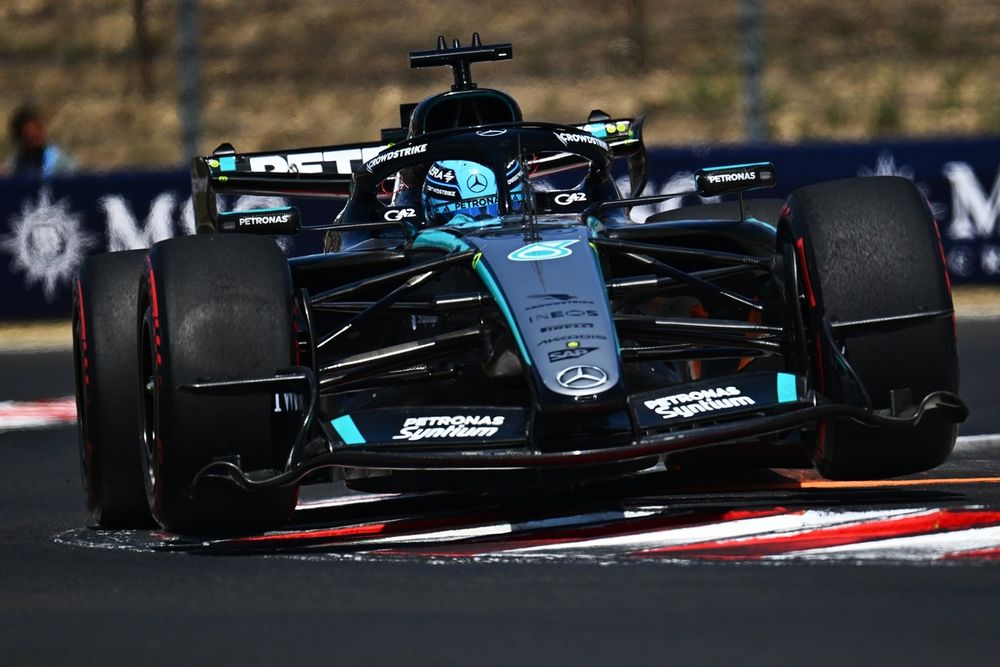
The Shocking Truth Behind Russell’s Hungarian GP Start Failure

Highlights
- George Russell’s Mercedes hit anti-stall, delaying start at Hungarian GP.
- Engine revs spiked uncontrollably due to turbo hybrid start sequence.
- Russell finished seventh, expressing frustration with team and situation.
- Mercedes identified throttle timing and battery charge caused turbo issues.
- Start sequence in Hungary lasted 13 seconds, longer than usual 10 seconds.
- Team to improve start strategy and support to prevent future errors.
George Russell’s Hungarian Grand Prix unravels at the start, as anti-stall and turbo-hybrid behavior leave his Mercedes crawling away. He salvages seventh while Mercedes accepts the need for procedural fixes.
When the lights extinguish, Russell applies modest throttle and the engine surges to maximum. Lifting then bogs the V6, triggers anti-stall, and surrenders grid spots amid Wolff’s visible frustration.

Russell reports erratic revs several seconds before the launch. His throttle inputs do not translate, leaving the power unit free-revving and unresponsive at the critical moment.
Mercedes’ initial review highlights Kimi Antonelli’s observation that Russell ‘hit the top of the pack’ and lost boost. In practice, that means exceeding a rev threshold that collapses compressor energy.
The 2026 power units demand sustained pre-launch revs to build exhaust energy and spool the turbo. With MGU-K assistance barred below 50 km/h, early boost becomes decisive for strong getaway.
Engine revs spiked uncontrollably before lights out, nullifying throttle response.
If revs overshoot, turbo load vanishes and the engine free-revs, degrading throttle authority. They echo Mercedes’ earlier findings on MGU-K load and battery state.
Hungary’s start sequence lasts about 13 seconds from blue lights to launch, longer than Spa’s near-10. Russell initiates throttle too early, overcharging the battery and hitting the boost ceiling.
The start sequence lasted roughly 13 seconds, exaggerating battery charge and turbo control problems.
From that point, any input spikes revs, so he lifts. Off-throttle, the engine drops out of the target band, worsening lag and making a clean bite off the line impossible.
Wolff cites too many mistakes, while Mercedes stresses shared responsibility. The team will refine start cues, driver support tools, and thresholds to stabilise the sequence across varying grid durations.
“We need to look at ourselves and ensure there’s nothing we’re doing wrong,” says Russell.
The result trims Russell’s points haul and extends a season he calls unlike any other. His ongoing challenge underlines Mercedes’ learning curve with 2026 procedures.
The weekend also exposes Hungaroring ride and bounce sensitivities that complicate starts and tyre prep.
Visual Summary
Turbo Start Disaster
George Russell’s Hungarian Grand Prix unraveled when his turbo boost dropped at the grid—leaving his Mercedes stuck as rivals roared away.
🔵
Throttle
Held
Throttle
Held
🔊
Rev
Spike
Rev
Spike
🛑
Boost
Drops
Boost
Drops
🚫
Mercedes
Stalls
Mercedes
Stalls
13s
Longest start sequence
Longest start sequence
0-50 km/h
NO battery allowed
NO battery allowed
7th
Race finish
Race finish
“I’m really not happy about too many mistakes that happen.” – Toto Wolff
🔍 Even teammate Antonelli noticed: “He lost boost.”
Mercedes & Russell must decode the turbo puzzle—before another race is lost at the grid.

Daniel Miller reports on Formula 1 Grand Prix weekends with race-day analysis, team-radio highlights, and point-standings updates. He explains power-unit upgrades, aerodynamic developments, and driver rivalries in straightforward, SEO-friendly language for a global F1 audience.