
https://shop.fervogear.com/cart

Max Verstappen Reveals Strategy Behind Lewis Hamilton’s Dive-Bomb Move

Highlights
- Verstappen made a clean, late-braking pass on Hamilton at Turn 1.
- Pass occurred on lap 16 during the 2024 Hungarian Grand Prix.
- Hamilton retook position but lost time due to pit lane speeding penalty.
- Verstappen finished second; Hamilton ended fifth behind Leclerc and Norris.
- Verstappen’s precise move contrasts with chaotic 2022 Hungary battle.
- Championship battle intensifies as season progresses with close competition.
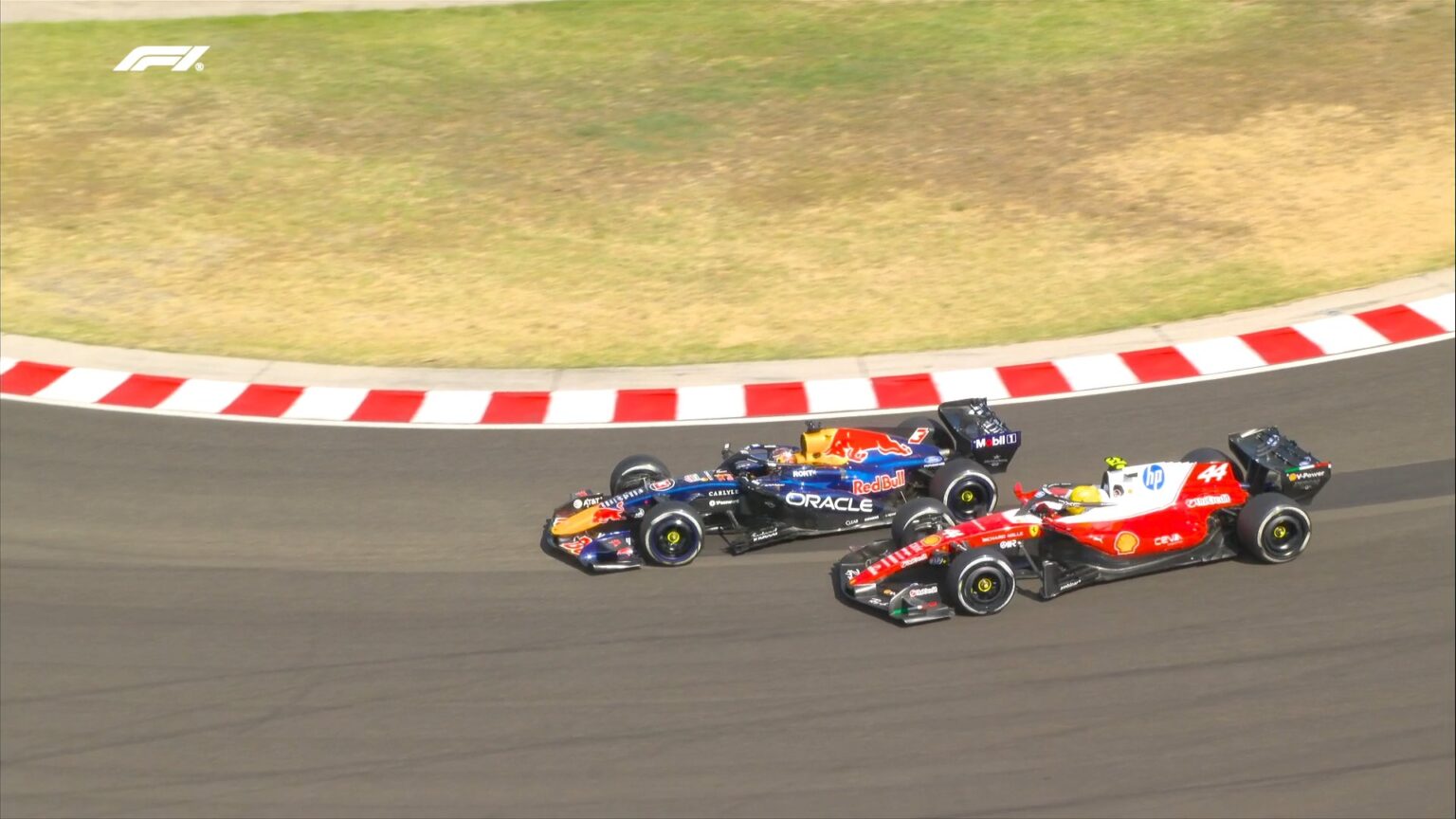
Max Verstappen reclaims third from Lewis Hamilton with a decisive Turn 1 move on lap 16 of the 2026 Hungarian Grand Prix at the Hungaroring, reshaping the podium fight.
The move follows Hamilton’s undercut at the previous stop, which vaulted his Ferrari ahead. Both closed on Liam Lawson into Turn 1, creating the opportunity Verstappen needed.

Braking late and committing early, Verstappen placed the RB22 inside Hamilton without contact. The pass was precise, controlled, and decisive enough to secure track position into the downhill sequence.
“I knew that was my only opportunity because their pace was not too bad,” Verstappen says. “When I saw the chance, I took it. It was a good move.”
Lap 16, Turn 1: Verstappen’s late-braking pass resets the race’s podium order.
The context matters. Two years earlier at the same corner, Hamilton locked both fronts and clipped Verstappen, briefly launching the Red Bull. Stewards deemed it a racing incident.
This time, risk management and precision define Verstappen’s approach. The clean exit prevents a repeat of 2024’s chaos and protects tyre life through the long Turn 2-3 sequence.
Hamilton later repassed on fresher tyres during his third stint, but momentum broke on lap 56. A Virtual Safety Car pit-lane speeding penalty, outlined in Hamilton’s Hungarian GP mistakes, undid the gains.
Lap 56 penalty for pit-lane speeding under VSC costs Hamilton crucial points.
Oscar Piastri’s gearbox failure triggered that VSC, compressing strategies and exposing marginal calls. Hamilton’s sanction dropped him behind Charles Leclerc as the race reset.
At the flag, Lando Norris wins for McLaren, Verstappen finishes second, and Hamilton takes fifth behind Leclerc. The points swing reflects execution as much as pure pace.
Norris wins; Verstappen takes P2; Hamilton finishes P5 behind Leclerc after a late penalty.
Red Bull’s call was straightforward once Verstappen gained track position. Clean air protected the fronts, stabilised thermal degradation, and let the RB22 exploit its strong traction on medium tyres.
Ferrari’s race hinged on timing and risk around traffic. Managing Lawson into Turn 1 proved costly, while the penalty converted a narrow podium fight into damage limitation for Hamilton.
Verstappen’s afternoon is not without headwinds. Balance shifts and traffic phases shaped his stint profiles, as discussed in Hungarian GP struggle analyses.
There were also questions about car condition and kerb strikes. Any underlying losses are explored in Verstappen’s Hungarian GP damage, which contextualises RB22 performance windows.
For Hamilton, the speed is present, but execution fluctuates. That pattern matches his recent downturn, examined in a broader form analysis.
The championship picture tightens. Verstappen’s judgement at decisive moments carries weight, while Hamilton must reduce operational errors to convert pace into results as the calendar intensifies.
Visual Summary
🏁
Verstappen’s Bold Dive: Turn 1, Lap 16 🇭🇺
⚡
Verstappen strikes in one perfect motion – clean, fearless, and decisive.
Lap 16: Slices past Hamilton, reclaims the podium spot.
“When I saw the chance, I took it, and yeah, it was a good move.”
– Max Verstappen
– Max Verstappen
2022
💥
Chaos
(contact)
💥
Chaos
(contact)
2026
🦾
Masterclass
(no contact)
Hungaroring, Turn 1: From Collision to Clinical
🥇
Norris
🥈
Verstappen
↑
🥉
Leclerc
Verstappen finishes P2
after a high-pressure duel
Hamilton drops to P5.
Penalty + mistake = lost points
after a high-pressure duel
Hamilton drops to P5.
Penalty + mistake = lost points
Experience & Split-Second Nerve: Verstappen’s clean pass is a blueprint for title fights.
Battle evolves, champions adapt. The race moves on.
Battle evolves, champions adapt. The race moves on.

Daniel Miller reports on Formula 1 Grand Prix weekends with race-day analysis, team-radio highlights, and point-standings updates. He explains power-unit upgrades, aerodynamic developments, and driver rivalries in straightforward, SEO-friendly language for a global F1 audience.