

https://shop.fervogear.com/cart

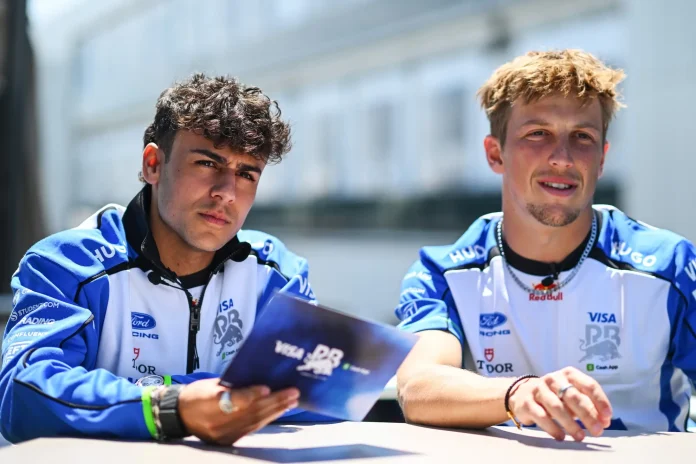
How Arvid Lindblad’s Insight Powered Liam Lawson’s Hungarian GP Triumph

Highlights
- Liam Lawson finished eighth, best outside top four teams.
- Arvid Lindblad advocated for a two-stop pit strategy.
- Lawson’s two-stop plan outperformed Hulkenberg’s one-stop approach.
- Lindblad’s one-stop strategy struggled with high race temperatures.
- Lindblad scored points for seventh consecutive race weekend.
- Racing Bulls showed strong reliability and adaptability at Hungarian GP.
Arvid Lindblad’s strategic read underpins Liam Lawson’s eighth place at the Hungarian Grand Prix. Racing Bulls extends its points run despite heat that stretches tyre life beyond one-stop expectations.
Lawson’s eighth-place finish is best of the rest behind McLaren, Red Bull, Mercedes, and Ferrari. His switch to a two-stop plan, informed by Lindblad, proves decisive in a tight midfield.

Lawson finishes eighth, best outside the top four teams.
Lindblad argues pre-race that track temperatures, around 20°C hotter than early practice, will drive higher wear. He pushes a split approach despite the team’s baseline one-stop modelling.
The call enables Lawson to exploit fresher tyres in clean air and late stints. His two-stop pace ultimately outmuscles Audi’s Nico Hulkenberg, whose one-stop gamble fades as degradation builds.
Gabriel Bortoleto and Lindblad persist with one-stoppers, initially competitive but increasingly vulnerable. As stint lengths grow, their lap times drift and track position slips away.
Lindblad extends his points-scoring run to seven consecutive race weekends.
Lindblad’s own one-stop initially looks viable. The hard compound overheats late, however, and the drop-off proves steeper than the models suggested for the hotter race trim.
Post-race, Lindblad accepts why the team hesitated pre-start. He maintains he pushed early for adding a second stop, mindful of the hard tyre’s heat sensitivity.
“Before the race, I could just feel it. The tyres don’t hold up well in the heat,” Lindblad says.
The result continues Lindblad’s points streak that began with the Canadian sprint, followed by six grands prix. That progress mirrors his growth charted in his first step towards regular scoring form.
Operationally, Racing Bulls shows flexibility and reliability. The team balances risk by splitting strategies and capitalises when rivals commit early or misjudge thermal management.
Lawson’s adaptability is a recurring theme in the squad’s momentum, as detailed in Racing Bulls’ recent form. The next objective is converting these reads into consistent top-eight finishes.
The Budapest weekend also reinforces Formula 1’s narrow execution margins in heat-affected events. That wider context, highlighted in Toto Wolff’s Hungarian GP reflections, underscores how pit timing and tyre care now decide the midfield.
Visual Summary
8⃣
Lawson
🏁
Lindblad
HU
Lawson’s split-second pit-stop gamble
Guided by Lindblad’s race sense, Racing Bulls split strategies.
Lawson’s bold two-stop call 🚦
(vs. rivals on one stop)
=> Highest-placed finisher outside F1’s Big 4
Guided by Lindblad’s race sense, Racing Bulls split strategies.
Lawson’s bold two-stop call 🚦
(vs. rivals on one stop)
=> Highest-placed finisher outside F1’s Big 4
Lindblad’s points streak
7 races
🔵🔵🔵🔵🔵🔵🔵
Winning Formula 1 battles isn’t always about raw pace—it’s who senses the right strategy when it matters.
Racing Bulls are learning fast.
Racing Bulls are learning fast.

Daniel Miller reports on Formula 1 Grand Prix weekends with race-day analysis, team-radio highlights, and point-standings updates. He explains power-unit upgrades, aerodynamic developments, and driver rivalries in straightforward, SEO-friendly language for a global F1 audience.