


https://shop.fervogear.com/cart

Max Verstappen Praises Red Bull’s Strong Response to Criticism

Highlights
- Verstappen praised Red Bull’s strong recovery at Italian GP.
- He finished third despite early practice session difficulties.
- Red Bull improved RB22 significantly after Zandvoort struggles.
- Verstappen noted RB22 still lags Mercedes on Monza straights.
- Energy deployment limits challenged car performance on high-speed track.
- Team aims for more upgrades to stay competitive in 2026.
Max Verstappen credits Red Bull for a swift recovery at Monza, turning a troubled build-up into third place. The result restores momentum and clarifies the RB22’s immediate ceiling at the Italian Grand Prix.
The weekend opens awkwardly. Mandatory rookie running sidelines Verstappen in FP1, and FP2 yields ninth amid balance complaints. That compromises learning time on a track where straightline efficiency dominates.

Red Bull anticipates trouble under energy deployment limits, a key Monza constraint, and Friday pace confirms the concern. The team lags rivals on the straights and struggles to optimise trade-offs during Friday’s sessions.
Overnight changes stabilize the platform and trim drag without sacrificing corner entry predictability. Verstappen qualifies sixth and gains a place through Oscar Piastri’s penalty, improving track position before inevitable straightline exposure.
Missing FP1 for rookie running compounds Red Bull’s setup deficit at Monza.
The race belongs to Mercedes. Kimi Antonelli and George Russell control the tempo, exposing Red Bull’s deployment shortfall. Verstappen manages tyres well but cannot dictate when to attack or defend.
Even in overtake mode, the RB22 fails to hold off on the main straight. The Virtual Safety Car offers brief windows, yet rivals’ top-end strength quickly reasserts itself.
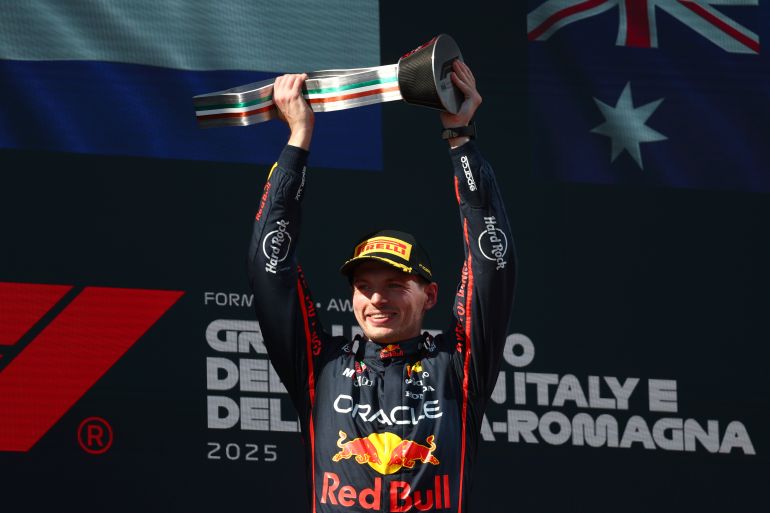
The podium still matters contextually. It follows Zandvoort’s bruising weekend, when Verstappen qualified seventh and crashed in the wet, and questioned the car’s compatibility with his style, as covered after Zandvoort’s setback.
Monza confirms the direction is better but incomplete. Power-unit energy deployment remains the defining weakness on high-speed circuits, effectively capping racecraft options when rivals open their own overtake modes and Verstappen feels held back.
Energy deployment on high-speed tracks remains Red Bull’s primary limitation.
The RB22’s Saturday step suggests correlation progress. Balance improves, traction phases look cleaner, and low-drag trim is less punitive through Lesmo and Ascari. Damage narrows, even if efficiency still lags.
Red Bull now targets iterative upgrades, seeking better harvesting and deployment strategies alongside aero efficiency gains for 2026. The aim is to close Mercedes on straights without compromising tyre management, aligning with upgrade targets for 2026.
Qualifying sixth, then promoted by Oscar Piastri’s penalty, proves crucial to securing third.
Visual Summary
🌧️
Zandvoort
Crash
P7 quali
P7 quali
🇮🇹
Verstappen
Podium Climb
Podium Climb
😤
Friday: Missed FP1
Ninth in FP2
Friday: Missed FP1
Ninth in FP2
⚔️
Battled Mercedes
Energy deficit
Battled Mercedes
Energy deficit
🥉
Finished 3rd
at Monza
Finished 3rd
at Monza
Red Bull & Verstappen
turn struggle into a podium climb
after early weekend woes at Monza
turn struggle into a podium climb
after early weekend woes at Monza
Still chasing rivals:
RB22 needs more power at high-speed tracks.
Momentum is building for the rest of 2026.

Daniel Miller reports on Formula 1 Grand Prix weekends with race-day analysis, team-radio highlights, and point-standings updates. He explains power-unit upgrades, aerodynamic developments, and driver rivalries in straightforward, SEO-friendly language for a global F1 audience.




