

https://shop.fervogear.com/cart

Mercedes’ Baku Domination Leaves F1 Rivals Scrambling for Answers

Highlights
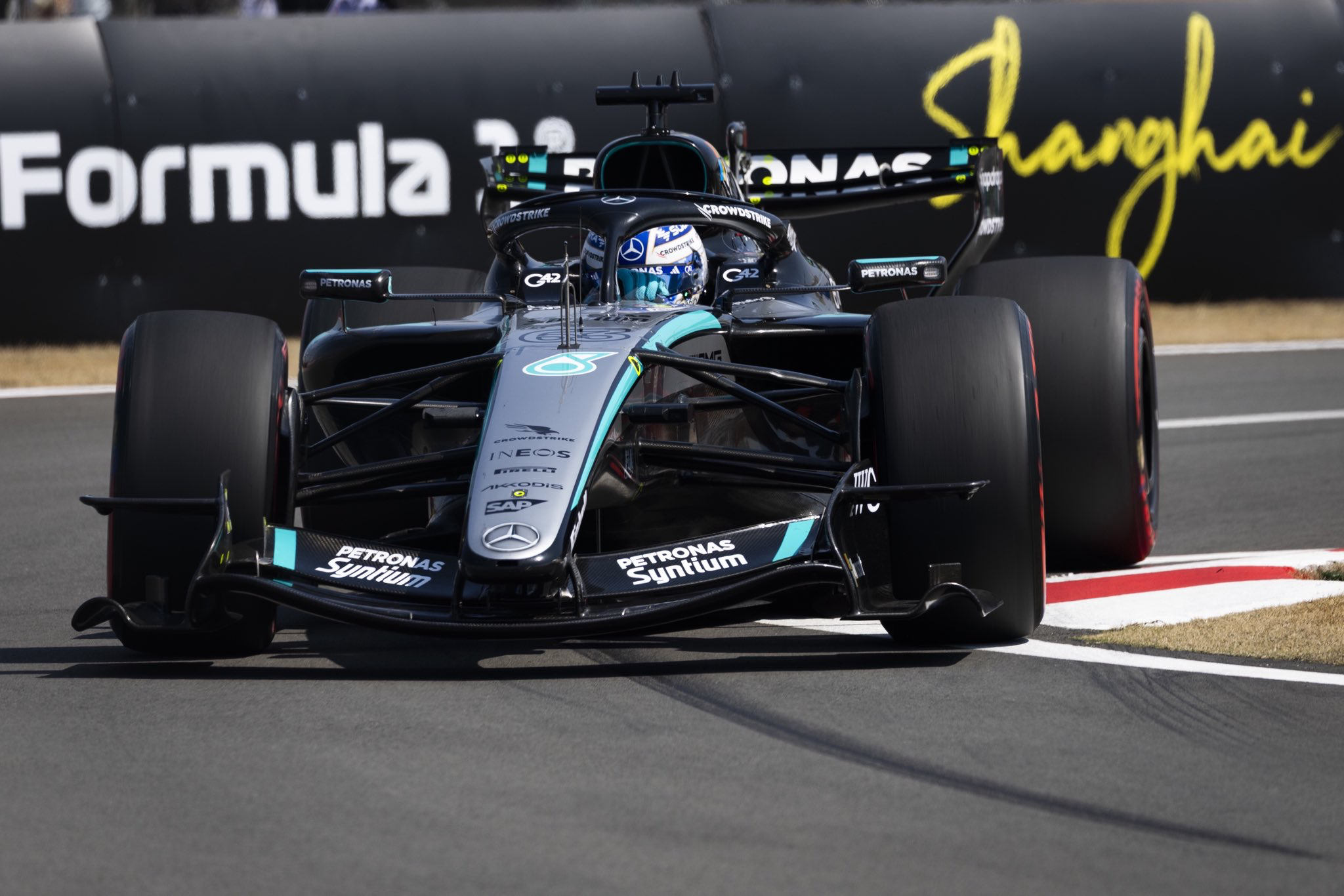
- Mercedes dominated both practice sessions at Azerbaijan Grand Prix.
- George Russell led with fastest times in FP1 and FP2.
- Red Bull introduced five upgrades but lagged behind Mercedes.
- Ferrari focused on qualifying preparations, no new upgrades added.
- McLaren faced technical issues after large upgrade package implementation.
- Qualifying was moved up to respect Azerbaijan’s National Day of Remembrance.
Mercedes sets the pace on Friday in Baku, with George Russell quickest in both sessions at the Baku City Circuit and Kimi Antonelli backing up a commanding start.
Russell’s FP2 benchmark of 1:43.347 leaves the nearest Red Bull eight-tenths adrift, a margin that looks too large to attribute solely to run plans or engine modes.

Russell tops FP2 with a 1:43.347, 0.827s clear of Verstappen’s best.
Antonelli completes a Mercedes one-two in FP2, underlining the W17’s suitability to Baku’s demands and confirming a robust baseline across varied fuel and tyre conditions.
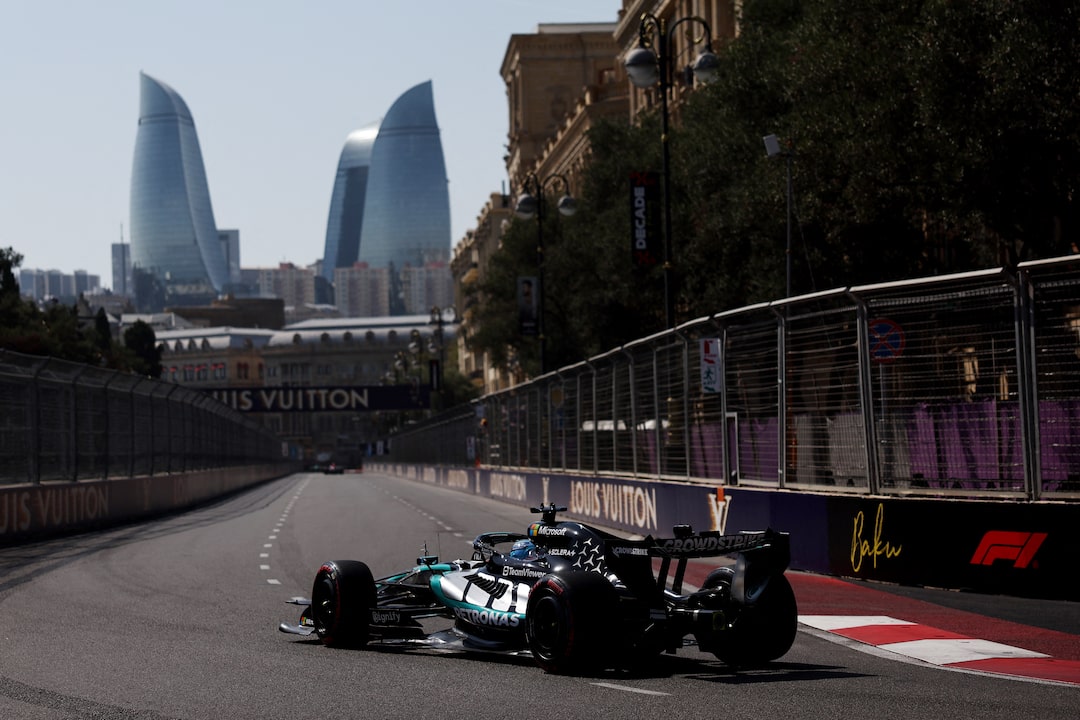
The advantage appears rooted in aerodynamic efficiency. Low drag on the 2.2km back straight, combined with stable braking, gives Mercedes a clean window to convert corner exits into lap time.
Notably, Mercedes and Ferrari add no new aero parts here, suggesting performance is coming from core design rather than fresh components, an encouraging sign under cost-cap constraints.
Red Bull brings five significant aero changes, billed as its last major 2026 development push.
Red Bull’s package includes revised floor and diffuser geometries, new cooling louvres, and altered floor split lines. Early data indicates the changes haven’t yet neutralised Mercedes’ straightline and braking strengths.
Max Verstappen is second in FP1 and third in FP2, but still 0.827s off Russell’s afternoon best. The deficit points to balance and efficiency gaps rather than execution alone.
Ferrari focuses on qualifying preparation without upgrades. Charles Leclerc and Lewis Hamilton take third and fourth in FP1, then slip to fourth and fifth in FP2 amid mixed single-lap execution.
The team struggles to hit tyre temperature targets consistently, particularly for peak grip. Whether that reflects car limitation or program choice will become clearer in qualifying.
McLaren’s broad update spans sidepod inlets, engine cover, floor edges, diffuser, rear suspension fairings, and the returning H-wing. Floor attachment issues disrupt running and cloud performance reads.
Oscar Piastri is sixth in FP1 and eighth in FP2. Lando Norris climbs from 14th to sixth. The intent is better slow-corner traction and improved stability on the long straights.
Baku’s layout magnifies setup trade-offs. Heavy braking into Turns 1 and 3, plus low early grip, exposes front locking and brake-balance sensitivities across the field.
Mercedes currently navigates that compromise best. With qualifying moved up to respect Azerbaijan’s National Day of Remembrance, the silver cars start as favourites on raw speed.
Saturday qualifying is rescheduled to honour Azerbaijan’s National Day of Remembrance.
The weekend context, strategies, and expected patterns were outlined in the 2026 Azerbaijan GP preview, with emphasis on straightline efficiency and braking consistency.
Further paddock insight, including run-plan diversity and set-up experiments, features in the latest Baku paddock stories and Thursday’s build-up coverage from trackside.
Visual Summary
Russell
1:43.347
Verstappen
+0.827s
Mercedes launches 0.8s clear on the Baku straight ➔
Ferrari
Feeling the Heat
Scuderia slips in late runs
Tyre warm-up woes
McLaren
Unstable
Upgrades interrupted 🔧
Attachment failures, variable pace
🛑
Heavy Braking
💨
Low Drag Focus
🧊
Tyre Warm-up
🔄
Upgrade Rush
Mercedes sets uncatchable pace in Baku practice.
Red Bull upgrades can’t close the gap.
Ferrari & McLaren on the back foot as qualifying looms.
Ferrari & McLaren on the back foot as qualifying looms.
Daniel Miller reports on Formula 1 Grand Prix weekends with race-day analysis, team-radio highlights, and point-standings updates. He explains power-unit upgrades, aerodynamic developments, and driver rivalries in straightforward, SEO-friendly language for a global F1 audience.