

https://shop.fervogear.com/cart

McLaren Unveils Game-Changing H-Wing Inspired by Key Lessons

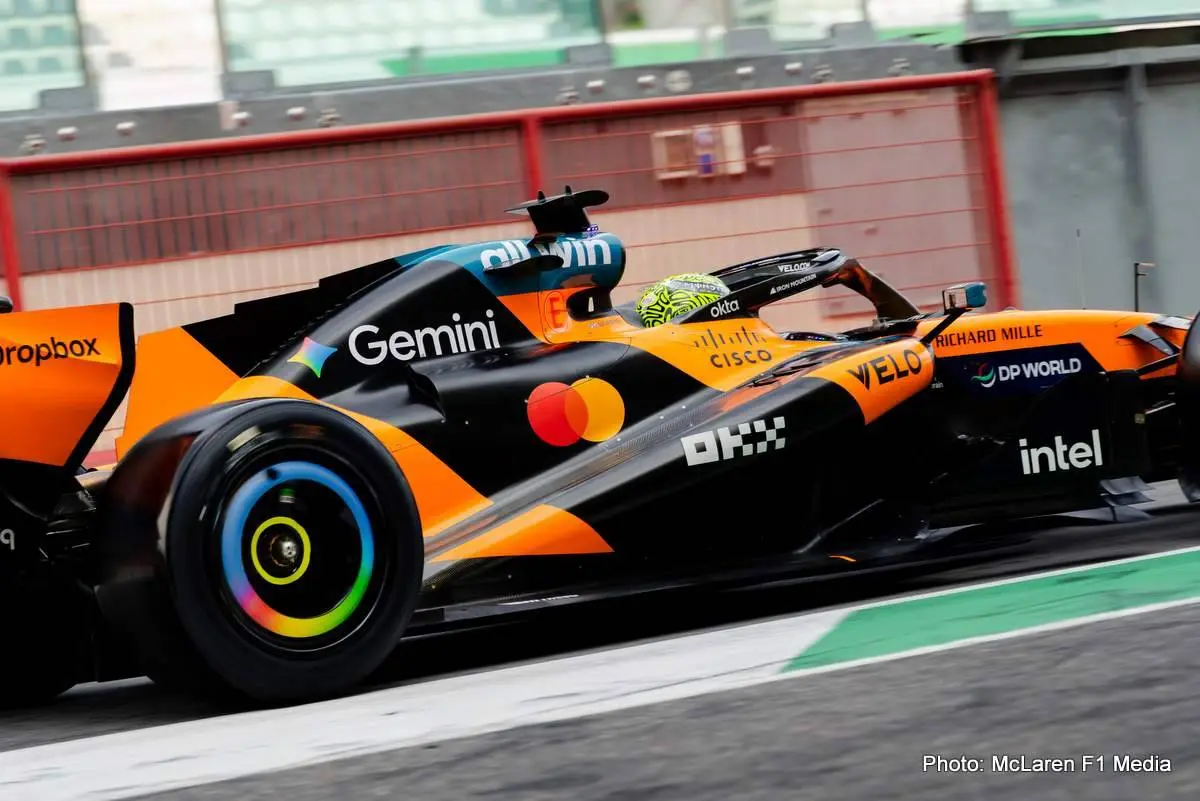
Highlights
- McLaren introduces H-Wing, inspired by Red Bull’s moveable rear wing.
- H-Wing uses a single central actuator to rotate flap nearly 180 degrees.
- McLaren focuses on reliable flap closing after Red Bull’s issues last season.
- Validation tests at Monza showed H-Wing performed well in high-speed sessions.
- H-Wing aims to improve speed and efficiency on Monza’s long straights.
- Active aero like H-Wing expected to grow under 2026 Formula 1 rules.
McLaren has debuted an H-Wing on the MCL40 at Monza, targeting low-drag gains on the straights. The device follows Red Bull’s moveable rear wing concept and has completed practice validation.
The concept mirrors Red Bull’s ‘Macarena’ solution, using a single central actuator to rotate the upper flap close to 180 degrees, pushing rearward from its leading edge.

This departs from multi-actuator endplate ideas trialled elsewhere. The geometry delivers a mechanical advantage during opening, demanding less effort from the actuator, as analyst Paolo Filisetti observes.
Closing is harder. Air pressure at high speed resists the motion, so returning the flap to the sealed position requires greater force and careful kinematic tuning.
That vulnerability surfaced last season when Red Bull suffered closure issues. Max Verstappen twice encountered a flap failing to shut, compromising corner entry, as detailed in Red Bull’s failure analysis.
The closing phase is the reliability-critical step; any delay can stop the flap from sealing.
McLaren has prioritised the closing phase. Adjustments to the actuator rod angle aim to guarantee prompt sealing under load, supported by upgrades tailored for Monza’s demands.
The H-Wing completed all Monza free practice sessions without issue.
The team judges the package race-ready. Absolute gains may be modest, but flipping the flap on long straights can trim drag and aid qualifying runs, especially at Monza.
Early running suggests a balanced trade-off between peak-straight performance and robustness, avoiding the oscillation and delay risks that undermine driver confidence at high speed.
Active aero will expand under 2026 rules; early mastery could be decisive.
With 2026 regulations expected to expand active aero, rivals will iterate similar mechanisms. McLaren’s measured adoption underscores incremental improvement on a proven idea and clear development accountability.
The competitive payoff should be strongest at power‑sensitive venues like Monza. Marginal straightline gains can shape tyre preparation, DRS strategy, and race management across tightly packed qualifying and race stints.
Visual Summary
H-Wing
↶
↶
⟲
FLIP TO FASTER
McLaren’s H-Wing debuts Monza
McLaren’s H-Wing debuts Monza
Inspired by Red Bull, redesigned by McLaren
🔄
Single actuator flips the wing nearly 180°
⚡
1st phase: Opens easily
2nd phase: Tough to close—high speed fights back
2nd phase: Tough to close—high speed fights back
✔️
Tested & reliable: survived Monza’s straights without malfunction
Every split-second counts: McLaren’s H-Wing could define the fastest moments at Monza—and beyond.

Daniel Miller reports on Formula 1 Grand Prix weekends with race-day analysis, team-radio highlights, and point-standings updates. He explains power-unit upgrades, aerodynamic developments, and driver rivalries in straightforward, SEO-friendly language for a global F1 audience.