
https://shop.fervogear.com/cart

Baku Low-Drag Edge Makes One F1 Team Dangerous in Azerbaijan GP


Highlights
- Mercedes excels in balancing low drag and rear stability at Baku
- Antonelli and Russell stood out in recent Monza and Spain races
- New 2026 power units challenge cars on Baku’s 2.2km straight
- Mercedes delays George Russell’s engine penalty until Americas triple-header
- Red Bull, led by Verstappen, is closing performance gap to Mercedes
- McLaren focuses on rookie Piastri but faces Baku’s tough conditions
Mercedes arrives in Baku targeting another strong weekend after Monza and Spain, where low drag and rear stability proved decisive. That blend maps neatly onto Azerbaijan’s demands.
Kimi Antonelli and George Russell headline recent form. Antonelli won in Monza and Spain, underlining Mercedes’ capacity to minimize drag without surrendering rear-end security through corners.

Baku’s 2.2km straight now stresses the 2026 power unit architecture. Power splits broadly between the combustion engine and a 350kW electrical system, with the removed MGU-H reducing delivery smoothness.
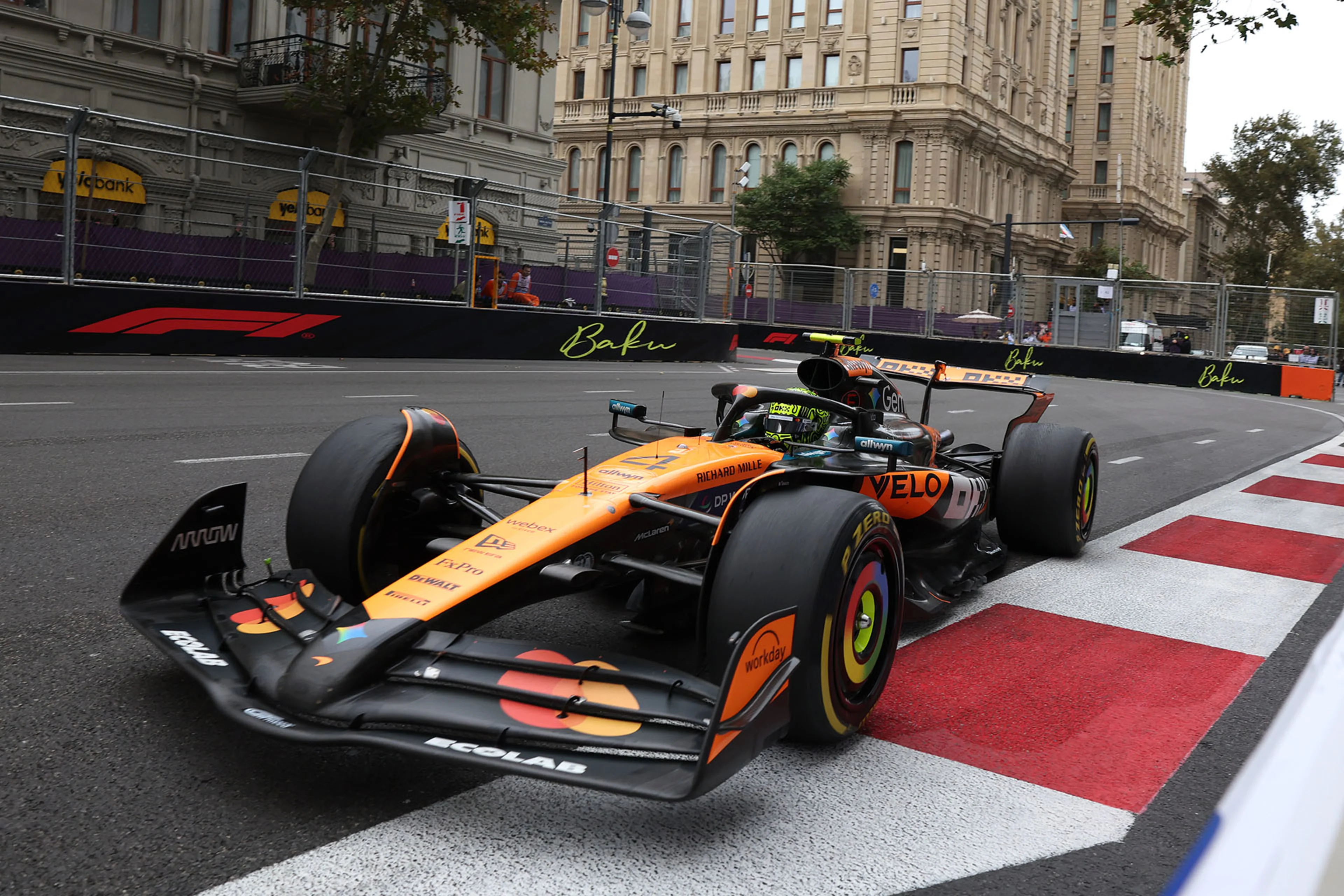
The straight is therefore a performance differentiator, not a simple flat-out zone. Teams must trade trimmed wings against sufficient load for the tight complexes and the narrow castle section.
The W17’s strength lies underfloor. It generates efficient ground-effect load, allowing more aggressive rear-wing trimming. That sustains traction in slow corners while delivering class-leading straight-line speed.
Mercedes’ W17 creates strong underfloor load, enabling a trimmed rear wing without sacrificing slow-corner traction.
That balance makes Mercedes the benchmark for Baku’s mixed profile. Red Bull has closed, though, with Max Verstappen taking four podiums from the last five starts despite Zandvoort’s crash.
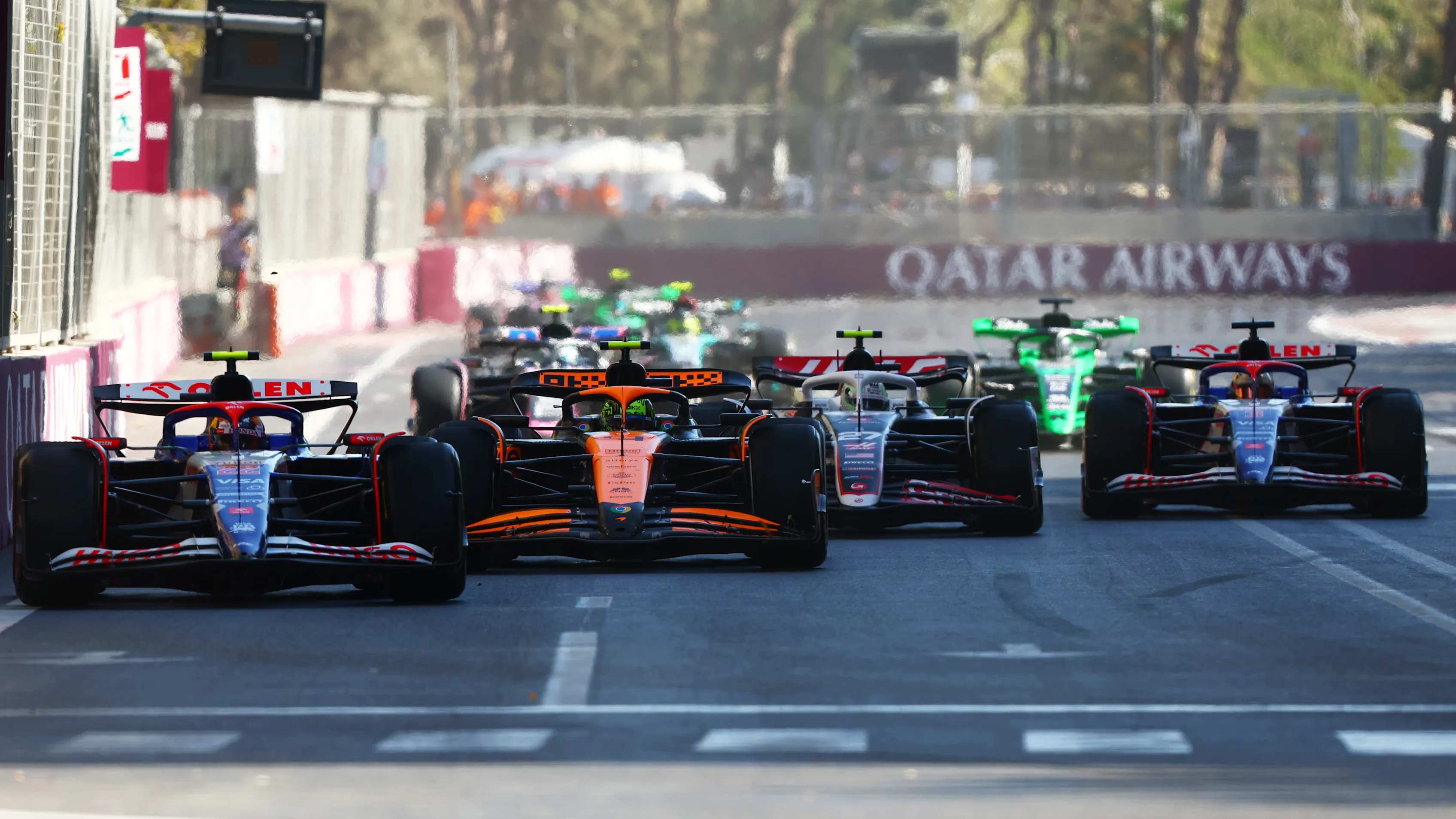
McLaren’s picture is mixed. Lando Norris won in Hungary and the Netherlands and finished third in Madrid, yet the MCL40 lagged in Monza’s low-downforce trim.
The team is directing engineering support toward Oscar Piastri, aligning setup with his preferences. Andrea Stella frames it as a technical exercise, not motivational, reflecting McLaren’s developmental focus.
Whether that translates on Baku’s punishing streets is unclear. Walls punish imprecision, and ride over kerbs stresses compliance. Any instability compounds through the castle section and the final braking zones.
Hard stops into Turns 1 and 3 amplify thermal risk. Cars decelerate from beyond 310km/h, demanding robust brake cooling. Borderline packages risk late-race fade and longer, less consistent pedal.
Energy deployment becomes race-critical. Teams must avoid early clipping before braking points while maximizing harvesting on-throttle and in braking. Under 2026 rules, that management often defines overtaking and defending.
2026 power units split output between ICE and 350kW electric, with no MGU-H—making energy management and harvesting decisive at Baku.
Strategically, Mercedes has opted to defer George Russell’s engine penalty to the Americas triple-header, pairing it with the ADUO upgrade. The decision prioritizes long-term points yield.
Russell has voiced frustration, questioning the timing. The trade-off is clear: track position in Baku versus consolidated grid pain later, likely offset by fresher hardware and recovery potential.
Mercedes will take Russell’s penalty during the Americas triple-header with the ADUO upgrade; Russell is unconvinced.
Ferrari upgraded its power unit for Monza yet still lacked straight-line efficiency. That deficit, and operational variability, underline Ferrari’s ongoing challenges under current and incoming regulations.
Baku’s lengthy flat-out section will expose any drag or deployment weakness. On paper, Ferrari again trails Mercedes and Red Bull, especially in race trim with thermal constraints.
Overall, Mercedes holds the strongest package for Azerbaijan. Red Bull stands as the primary threat. McLaren and Ferrari face questions, with Friday qualifying compressing preparation and raising operational pressure.
Visual Summary
Mercedes: Best Balanced in Baku
Fastest on the 2.2 km straight
Dominant under low-drag, challenging corners
Dominant under low-drag, challenging corners
Baku Top Contenders:
Mercedes
Red Bull
McLaren
Ferrari
⚡
New power rules = unpredictable surges on Baku’s straight.
350kW electric boost, but no MGU-H means trickier energy management — smart teams will make the final laps count.
New power rules = unpredictable surges on Baku’s straight.
350kW electric boost, but no MGU-H means trickier energy management — smart teams will make the final laps count.
⏱️
Qualifying on Friday: Maximum pressure; no margin for mistakes.
Setup and reaction time are ultra-limited — every lap counts.
Qualifying on Friday: Maximum pressure; no margin for mistakes.
Setup and reaction time are ultra-limited — every lap counts.
🟥
Baku’s walls are ruthless: braking from 310+ km/h into Turn 1 will decide fates.
Brakes under stress; slightest overheat = disaster at the endgame.
Baku’s walls are ruthless: braking from 310+ km/h into Turn 1 will decide fates.
Brakes under stress; slightest overheat = disaster at the endgame.
🏁
Kimi Antonelli
Back-to-back wins at Monza & Spain
⏳
George Russell
Engine penalty delayed = frustration
🐂
Max Verstappen
4 podiums in 5 — Red Bull closes gap
⚡ All eyes on Mercedes: Will Baku’s walls and new power rules spark an upset?

Daniel Miller reports on Formula 1 Grand Prix weekends with race-day analysis, team-radio highlights, and point-standings updates. He explains power-unit upgrades, aerodynamic developments, and driver rivalries in straightforward, SEO-friendly language for a global F1 audience.