

https://shop.fervogear.com/cart


Charles Leclerc Urges Ferrari to Sharpen Race Strategy Now

Highlights
- Leclerc urges Ferrari to learn from Red Bull’s race strategy.
- Ferrari started Bahrain GP on soft tyres, Red Bull chose intermediates.
- Early pit stop on lap one disrupted Ferrari drivers’ race rhythm.
- Verstappen won his 72nd Grand Prix starting from pole position.
- Ferrari kept both drivers on same tyre, unlike other teams.
- Ferrari aims to refine strategy under changing weather conditions.
Charles Leclerc urges Ferrari to study Red Bull’s decision-making after a costly tyre call at Sepang, where starting both cars on slicks left them on the back foot immediately.
Leclerc and Lewis Hamilton lined up on softs as rain lingered, while Max Verstappen and Isack Hadjar chose intermediates. The mismatch exposed Ferrari to immediate losses off the line.

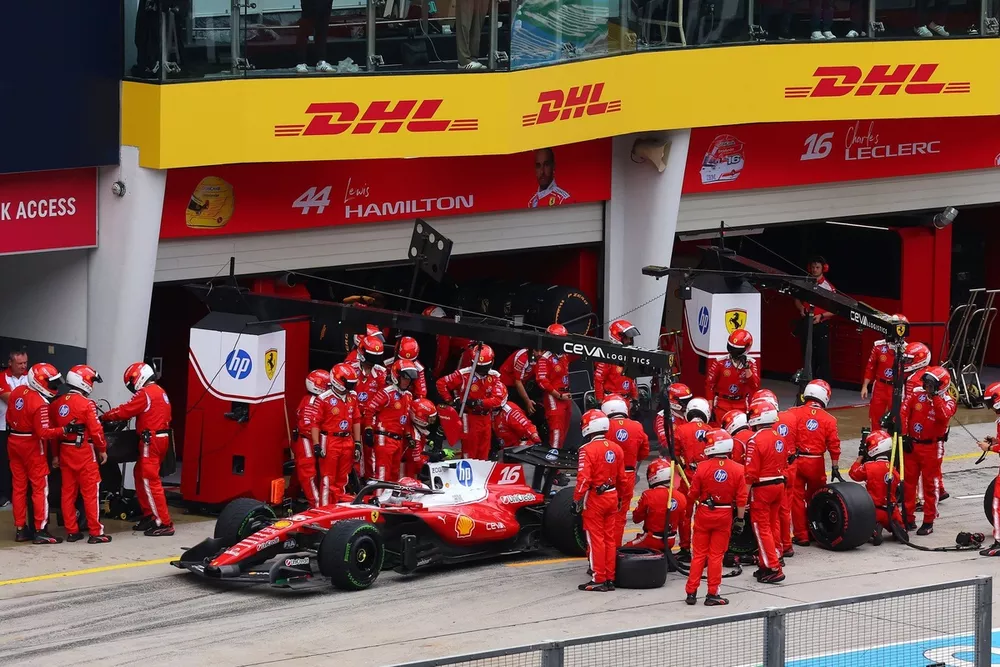
An early stop on lap one destroyed Ferrari’s rhythm on a damp track.
Leclerc pitted at the end of lap one as grip proved marginal, dropping him to the pack’s tail and fracturing Ferrari’s race plan before it could stabilise.
Ferrari often oscillates between sharp calls and high-profile misses. Team principal Frederic Vasseur accepts strategy remains a work in progress within evolving processes and decision-support tools.
Red Bull, orchestrated by strategist Hannah Schmitz, executed cleanly. Verstappen converted pole into his 72nd victory, underlining a repeatable playbook and the complexity of F1 strategy it routinely masters.
Verstappen sealed his 72nd Grand Prix win from pole at Sepang.
The crux was risk distribution. Ferrari kept both cars on the same tyre, whereas rivals split choices to hedge against misreads of track evolution and standing water.
Ferrari kept both drivers on the same compound instead of splitting strategies.
Leclerc conceded the judgement call looked defensible beforehand but proved wrong. He noted uncertainty over water trapped in tarmac hollows, which sustained inters’ crossover longer than models suggested.
Most runners abandoned intermediates by lap 13. Because Ferrari started on slicks, its recovery hinged on damage limitation, tyre temperature management, and timely undercuts amid changing grip.
Both Ferrari drivers rallied. Hamilton and Leclerc climbed to third and fourth after strong middle stints, assisted by George Russell’s late Mercedes retirement with a power-unit issue.
“We thought we were doing the right thing,” Leclerc said, praising Red Bull’s consistency under uncertainty.
Leclerc’s assessment was pragmatic: the early deficit offset later pace, leaving the finishing positions broadly representative. Detail from his Sepang weekend supports that view.
For Ferrari, the lesson is procedural. Enhancing pre-start scenario trees, splitting strategies more decisively, and refining wet‑to‑dry crossover criteria are essential to threaten Red Bull consistently.
Red Bull’s benchmark remains daunting as it chases its next milestones, yet Ferrari’s raw pace is competitive. Execution, not speed, dictated the outcome at Sepang.
Visual Summary
?
Ferrari’s Strategy Gamble Goes Flat ⚖️
Leclerc calls for Ferrari to learn from Red Bull’s razor-sharp race decisions after Bahrain tyre mix-up.
Ferrari
P2 ➔ P15
(Wrong tyre, pit on lap 1)
P2 ➔ P15
(Wrong tyre, pit on lap 1)
⬇
vs
⬆
Red Bull
Pole ➔ WIN
(Intermediates, managed risk)
Pole ➔ WIN
(Intermediates, managed risk)
⚫
+
⚫
+
⚫
Both Ferrari cars started on softs—no split in strategy.
Red Bull hedged risks with both cars on intermediates.
Weather uncertainty turned caution into victory.
Red Bull hedged risks with both cars on intermediates.
Weather uncertainty turned caution into victory.
Final Top 4 at Sepang
1️⃣ Verstappen
2️⃣ Antonelli
3️⃣ Hamilton
4️⃣ Leclerc
“Red Bull seems to get this right most of the time with both their cars.”
– Charles Leclerc, reflecting on a strategy slip-up Ferrari can’t afford if they want to steal Red Bull’s thunder.

Daniel Miller reports on Formula 1 Grand Prix weekends with race-day analysis, team-radio highlights, and point-standings updates. He explains power-unit upgrades, aerodynamic developments, and driver rivalries in straightforward, SEO-friendly language for a global F1 audience.