

https://shop.fervogear.com/cart

FIA President Fernando Alonso Shares Insights on F1’s ADUO Impact


Highlights
- Ben Sulayem pledges extra engine support to Fernando Alonso’s Honda
- Alonso and Lawrence Stroll discuss Aston Martin struggles with FIA
- ADUO system offers development help to Honda amid power unit issues
- Honda received $19M additional budget and increased dyno hours
- Red Bull and Mercedes also involved in disputes over ADUO rules
- FIA to review ADUO system and possible further Honda support offseason
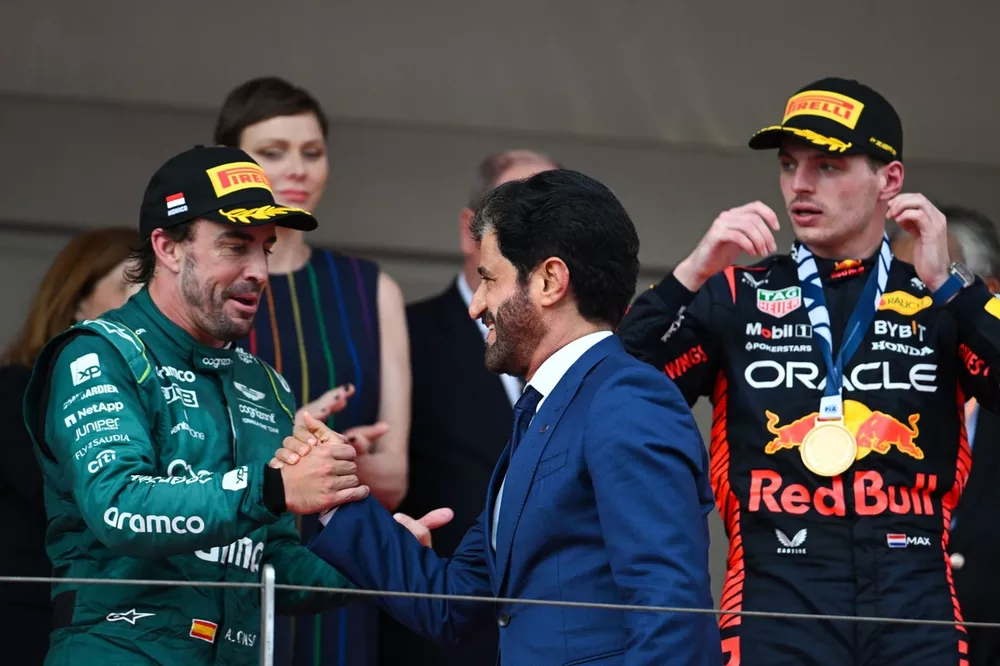
FIA president Mohammed Ben Sulayem signals willingness to widen engine concessions for Honda to aid Fernando Alonso and Aston Martin, following talks in Madrid before the Spanish Grand Prix.
Alonso and owner Lawrence Stroll set out the partnership’s struggles directly to Ben Sulayem, who fears the sport could lose a major draw if competitiveness wanes amid renewed Aston Martin retirement speculation.

At 45, Alonso has criticised the current power-unit framework and has not confirmed plans for next year, sharpening the stakes around technical support and regulatory flexibility.
The immediate lever is the FIA’s Additional Development and Upgrade Opportunities scheme, devised to prevent newcomers repeating Honda’s 2015 struggles with an uncompetitive package.
Ironically, Honda now leans on ADUO while Red Bull-Ford and Audi show solid early progress. Eligibility rests on V6-only performance metrics, not overall power-unit competitiveness.
Since May, Honda secured $19M extra budget and 230 dyno hours, up from 190, under ADUO provisions.
Support can include extra dyno time, added budget-cap headroom, and mid-season upgrade tokens. Only V6 output triggers access, yet tokens can be applied across the full power unit.
That asymmetry drives tactical behaviour, with some manufacturers tempering V6 output to preserve development latitude. Red Bull argues the framework has unfairly compromised its programme.
Only V6 performance determines ADUO access, even though tokens can upgrade any part of the power unit.
Mercedes, widely viewed as strongest on hardware, also qualifies under the same V6-centric metric, underscoring the scheme’s quirks and its political friction.
Manufacturers shaped the thresholds, while the FIA pushed for broader measures. The row has stalled wider engine-rule rethinks, including any V8 return talk, with details outlined in the FIA ADUO ruling.
Ben Sulayem remains open to offseason revisions and potentially more Honda help. Several rivals, including Toto Wolff, frame ADUO as a necessary catch-up tool for outliers.
Ben Sulayem says Alonso should exit by choice, not through lack of competitiveness.
Concrete assistance is already banked. Honda gained $19M over two years, split between an $11M deficit allowance and an $8M advance against future budgets.
Dyno allocation increased to 230 hours from 190. The key unknown is timing—whether additional measures can land quickly enough to deliver tangible gains for Alonso.
Alonso’s next steps remain undecided and closely tied to progress, as explored in coverage of Alonso’s retirement decision.
Aston Martin’s trajectory is similarly pivotal, with contract dynamics and timing pressures outlined in analysis of Alonso’s contract delay.
Strategically, Honda has used only one of its two ADUO tokens this season, leaning toward a comprehensive 2027 unit over incremental 2026 gains.
Red Bull is expected to seek adjustments after exposing weaknesses in the ruleset, while Mercedes welcomes clearer guardrails to preserve competitive balance.
For now, Aston Martin and Honda face a long road back. Any offseason reset must translate political will into dyno hours, budget efficiency, and measurable lap time.
Visual Summary
🟢
Age 45
🤝
FIA
⚡
Honda
🐂
Red Bull
Red Bull
⭐
Mercedes
Mercedes
Alonso’s Future Pulls the Sport in Every Direction
45-year-old Alonso faces losing competitiveness
Honda gets $19M & bonus hours to catch up
FIA vows to keep legends in the race—not forced out
Honda gets $19M & bonus hours to catch up
FIA vows to keep legends in the race—not forced out
Honda Relief
+230 hrs
🟢 Alonso ·
🤝 FIA ·
⚡ Honda ·
🐂 Red Bull ·
⭐ Mercedes
🤝 FIA ·
⚡ Honda ·
🐂 Red Bull ·
⭐ Mercedes

Daniel Miller reports on Formula 1 Grand Prix weekends with race-day analysis, team-radio highlights, and point-standings updates. He explains power-unit upgrades, aerodynamic developments, and driver rivalries in straightforward, SEO-friendly language for a global F1 audience.