
https://shop.fervogear.com/cart

Discover Which Tyres Teams Will Use at the Bahrain Grand Prix

Highlights
- Pirelli selects C2, C3, and C4 tyre compounds for 2026 Malaysia GP
- Each driver gets two hard, three medium, and eight soft tyre sets
- Drivers must use two different slick compounds during dry race conditions
- Sepang track resurfaced; thermal management and tyre wear expected challenges
- Limited current data makes Friday practice sessions crucial for teams
- Tyre choices aim to widen strategic options for one-stop and two-stop
Pirelli has confirmed the C2, C3 and C4 compounds for the 2026 Malaysia Grand Prix at Sepang, marking Formula 1’s return to the venue after nine years.
Pirelli nominates C2–C4 for Sepang’s 2026 return.
Each driver has two hard sets, three medium sets and eight soft sets, plus intermediates and full wets for rain.

An extra soft set is reserved for Q3 qualifiers. In a dry race, two different slick compounds must be used.
Pirelli characterises Sepang as a medium-energy circuit, comparable to Spa and Shanghai.
Sepang’s resurfacing and heat make thermal management decisive across both axles.
Temperature control should prove decisive amid variable ambient and track conditions expected across practice, qualifying and the race.
The nomination is slightly more aggressive than a conservative harder set, designed to compress one-stop and two-stop strategy gaps.
Expected stint-length deltas and undercut power are analysed in the 2026 Bahrain GP watch, useful context for teams modelling Sepang.
Sepang’s abrasive surface mirrors Bahrain’s roughness yet features distinct loading profiles through its long corners and heavy traction zones.
Grip will likely be limited on Friday, then improve as the circuit rubbers in and the surface evolves.
Recent works include resurfacing, levelling and deep cleaning to stabilise the asphalt and reduce bumps ahead of the Grand Prix.
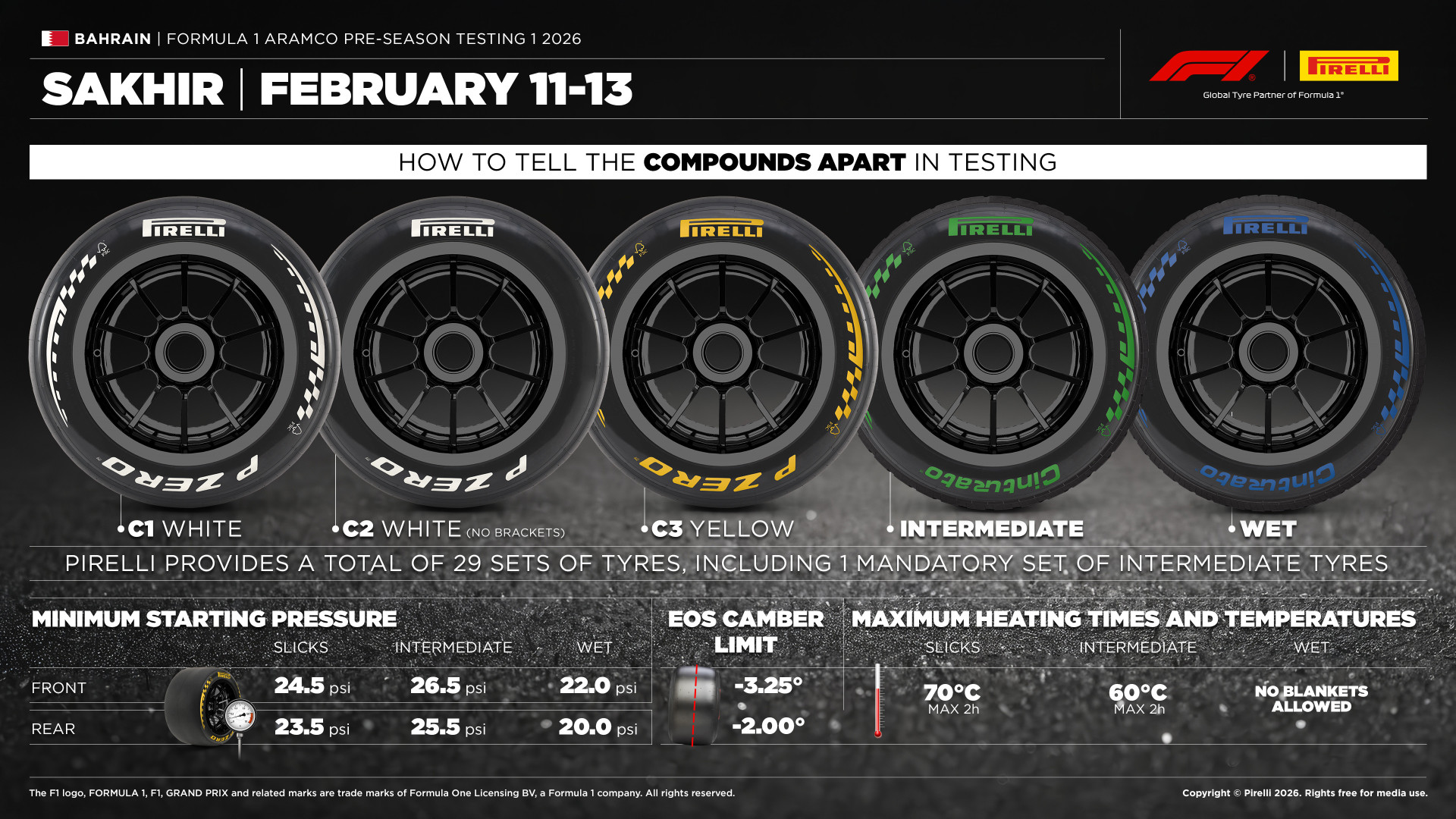
Drivers must run at least two slick compounds if conditions stay dry.
Because F1 has been absent from Malaysia and car concepts have evolved, teams lack recent references for this layout.
Friday practice therefore becomes a discovery exercise for balance targets, warm-up characteristics and tyre degradation mapping.
Run plans will prioritise high-fuel wear profiles and qualifying warm-up, aligned to the 2026 F1 Bahrain schedule timing windows.
Front-limited sections will stress the left-front, while traction zones punish the rears. Teams will tune camber, pressures and brake blanking to manage temperatures.
Allocation: two hard, three medium and eight soft sets per driver.
With C2–C4, crossover points should keep pit windows flexible and encourage offsets, particularly if degradation splits compounds differently front to rear.
Longer-term construction and compound direction feeds into development paths outlined in F1 tyres 2027.
Parallel advances in electric-series tyres, such as Bridgestone’s Formula E tyres, highlight materials and processing innovations that can inform F1.
Pirelli’s selection should produce meaningful strategic variance, with thermal management and evolving grip dictating who unlocks Sepang’s pace.
Visual Summary
C2
HARD
2 Sets
C3
MED
3 Sets
C4
SOFT
+1 Q3
8 Sets (+1 for Q3)
2026 Bahrain GP on Malaysian soil!
Tyre strategy is king:
C2 Hard,
C3 Medium,
C4 Soft.
Softer choices, more strategy, unknowns for every team.
C2 Hard,
C3 Medium,
C4 Soft.
Softer choices, more strategy, unknowns for every team.
Track Grip Evolution
FRI
SAT
SUN
SAT
SUN
Grip builds all weekend as new asphalt evolves.
🇲🇾
First F1 race at Sepang since 2017. Drivers face unknowns with fresh surface and little data.
First F1 race at Sepang since 2017. Drivers face unknowns with fresh surface and little data.
INTERS (Green)
WET (Blue)
Compounds must be mixed for a dry race
WET (Blue)
Compounds must be mixed for a dry race

Daniel Miller reports on Formula 1 Grand Prix weekends with race-day analysis, team-radio highlights, and point-standings updates. He explains power-unit upgrades, aerodynamic developments, and driver rivalries in straightforward, SEO-friendly language for a global F1 audience.