
https://shop.fervogear.com/cart


Inside the Thrilling Contest Shaping F1’s Top Engineering Talent

Highlights
- 2026 STEM Racing had 91 teams from 36 countries.
- Teams built miniature CO2-powered F1 cars reaching 70 km/h.
- Competition includes engineering, marketing, and project presentation skills.
- Alumni include engineers at Red Bull Ford and Aston Martin.
- STEM Racing runs for 26 years, now includes programs for kids.
- F1 teams see competition as a valuable engineering talent source.
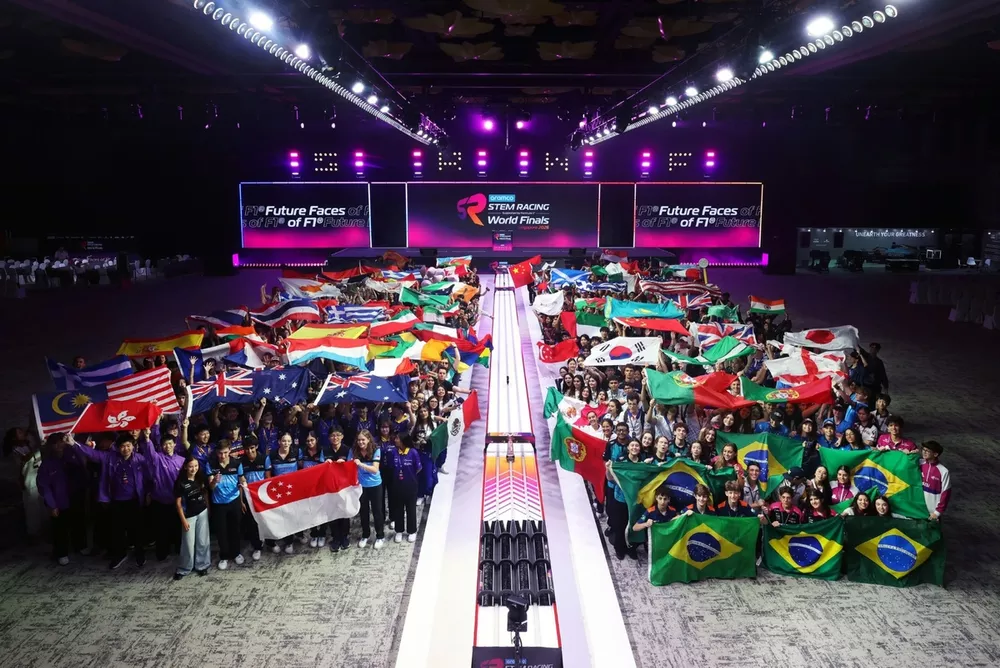
Hundreds of students gather in Singapore for the 2026 STEM Racing World Final, a now-established pathway for aspiring motorsport engineers, staged in the build‑up to the Singapore Grand Prix.
This year’s event is the biggest yet: 91 teams from 36 countries, each with three to six students, racing CO2-powered mini F1 cars over 20 metres at up to 70km/h.

Strict regulations and scrutineering mirror Formula 1, demanding credible aerodynamic development, weight control, and manufacturing discipline before cars are approved to run.
Teams deploy professional toolchains: CAD and CFD for design, CNC routers and 3D printers for manufacture, before precision assembly, surface finishing, and measurement to correlate ideas with performance.
The brief extends beyond engineering. Squads build brands, construct pit displays, deliver judged presentations, and create sponsorship proposals that test planning, budgeting, leadership, and consistency under time pressure.
2026 set a new benchmark: 91 teams representing 36 countries competed in Singapore.
Spectrum’s Noah, third overall in 2026, highlights learning to collaborate under pressure. Nebula’s Aarav points to creativity and technical depth gained by competing against high-calibre international opposition.
Outcomes vary, but the pathway is proven. Alumni include Kyriakos Theofanidis at Red Bull Ford Powertrains and James Mitchell at Aston Martin, both leveraging competition experience into professional roles.
Williams engineer Laurence Vines, now a mentor and judge, credits early exposure to CAD and CFD with accelerating university progress and smoothing the transition into Formula 1 environments.
F1 teams increasingly treat the competition as a live talent pipeline for future engineers.
Founder Andrew Denford emphasises reach and progression. In its 26th year, STEM Racing now offers tiered programmes starting at age six, building complexity with experience and available resources.
Rising global interest, helped by documentary storytelling, drives larger entry lists and higher standards. Teams increasingly treat the event as a live recruitment window for future engineering capability.
Students also touch real-world concepts such as reliability management, including system stress and fatigue, while balancing performance gains against risk within tight resource and regulatory constraints.
McLaren racing director Randy Singh underlines the link. Graduate schemes and early engagement identify adaptable engineers who can deliver in fast, iterative environments sustained by data, process, and collaboration.
For teenagers, Singh recommends joining team-based technical activities that mirror real project dynamics, sharpening problem-solving, communication, and accountability long before university.
The miniature cars accelerate to around 70km/h over just 20 metres.
Whether their destination is F1, aerospace, or other sectors, competitors leave Singapore with practical experience, confidence, and a clearer route into high-performance engineering careers.
Visual Summary
91
Teams
2026
Teams
2026
70 km/h
Top Speed
Miniature F1
Miniature F1
36
Countries
represented
represented
6–18
Age range
of challengers
of challengers
“
Learning from peers worldwide and seeing so much creativity inspired me!”
— Aarav, Singapore
Learning from peers worldwide and seeing so much creativity inspired me!”
— Aarav, Singapore
“
This taught me to work under pressure—just like real racing.
— Noah, Germany
This taught me to work under pressure—just like real racing.
— Noah, Germany
🏁
STEM Racing
F1 Careers
→
F1 Careers
→
Alumni now at Red Bull • Aston Martin • Williams
Their journey started here.
Their journey started here.
STEM Racing Finals: Launching future engineers — and F1 dreams.

Daniel Miller reports on Formula 1 Grand Prix weekends with race-day analysis, team-radio highlights, and point-standings updates. He explains power-unit upgrades, aerodynamic developments, and driver rivalries in straightforward, SEO-friendly language for a global F1 audience.