

https://shop.fervogear.com/cart


Which Tyres Will Teams Choose for Thrilling United States GP?


Highlights
- Pirelli selected C2, C3, and C4 compounds for 2026 US Grand Prix
- Drivers get two hard, three medium, and eight soft tyre sets
- Extra soft tyre set reserved for Q3 qualifying drivers
- Dry race requires use of at least two different slick compounds
- Circuit length is 5.513 km with fast corners and traction demands
- High temperatures may increase tyre degradation, influencing race strategies
Pirelli nominates C2, C3 and C4 for the 2026 United States Grand Prix at Austin’s Circuit of The Americas, a choice set to influence tyre strategy throughout the grid.
The selection differs from last year’s Sprint event, which used non‑consecutive C1, C3 and C4. This weekend follows the traditional Grand Prix format, with practice, qualifying and the race separated.

Teams receive two sets of hard tyres, three medium sets and eight soft sets. Intermediates and full wets are available if conditions demand.
Pirelli’s C2‑C3‑C4 nomination restores a consecutive range for Austin.
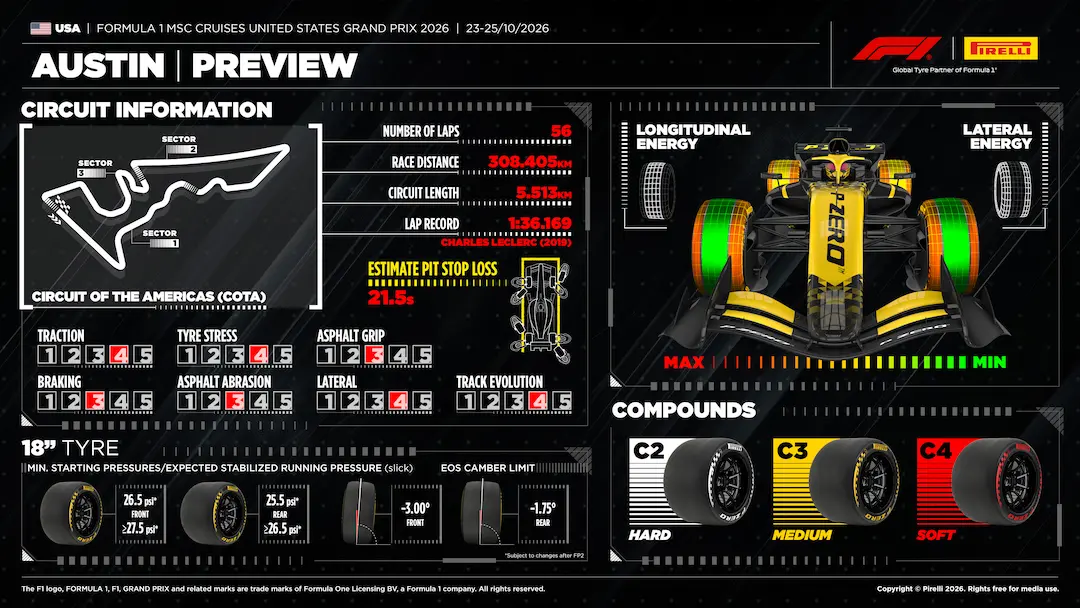
Drivers reaching Q3 gain an additional soft set for qualifying. In a dry race, regulations require at least two different slick compounds to be used.
COTA’s 5.513km layout blends high‑speed direction changes with slow‑corner traction demands. Straight‑line efficiency must be balanced against aerodynamic load for the lap’s more technical sections.
The fast, uphill first sector loads the front tyres during quick changes of direction. Sector three’s acceleration zones increase rear‑tyre temperatures, with thermal wear a persistent concern.
A section between Turns 9 and 11 was resurfaced, while the older asphalt elsewhere continues to drive wear. Degradation, rather than graining, is likely to dictate stint length.
Fresh asphalt between Turns 9 and 11 introduces a small variable for wear.
On paper, the C2 hard looks the most durable race tyre, opening a one‑stop. That relies on controlled rear temperatures and limited traffic during the critical middle stint.
High ambient and track temperatures in Texas can tilt strategies toward two stops. Protecting the rears out of slow corners will be central to stint length and stop timing.
Dry races mandate at least two different slick compounds.
Setup will prioritise front‑end response without overworking the rears. That balance is sharpened by recent compliance scrutiny following the floor stay trick ban and ongoing aero load sensitivities.
Expect leaders such as Red Bull to target strong front bite through Sector 1 while safeguarding traction for Sector 3, with car efficiency dictating viable stint lengths.
The event runs as the Cadillac United States Grand Prix, with support series helping rubber the surface. That evolution should aid grip but will not eliminate rear‑limited degradation.
Ultimately, the race will hinge on managing degradation, exploiting the compound spread, and timing stops around traffic and potential interruptions.
Visual Summary
I
Inter
W
Wet
C2
Hard
2 sets
C3
Medium
3 sets
C4
Soft
8 sets
+1 Q3
Degradation
High tyre wear
🔥
Austin’s COTA features increased rear-tyre stress in final sector
Traditional GP Format
Mandatory 2-compound use
Softer than 2025
New surface: T9-T11
Tyre management will be crucial at Austin!
With high rear-degradation, the C2 hard is the pitstop hero—but the brave may risk softs under Texas heat…
With high rear-degradation, the C2 hard is the pitstop hero—but the brave may risk softs under Texas heat…

Daniel Miller reports on Formula 1 Grand Prix weekends with race-day analysis, team-radio highlights, and point-standings updates. He explains power-unit upgrades, aerodynamic developments, and driver rivalries in straightforward, SEO-friendly language for a global F1 audience.