
https://shop.fervogear.com/cart


Honda Faces Surprising Setback After Second F1 Power Unit Upgrade

Highlights
- Honda’s second power unit upgrade failed to solve turbo lag issues.
- Turbo lag affected Aston Martin AMR26’s driveability at Singapore GP.
- Honda found no hardware faults; focus shifts to software solutions.
- Energy-intensive Singapore track intensified turbo lag and unstable acceleration.
- MGU-K provided some help but insufficient on energy-demanding circuits.
- Aston Martin plans software improvements to better control turbo lag.
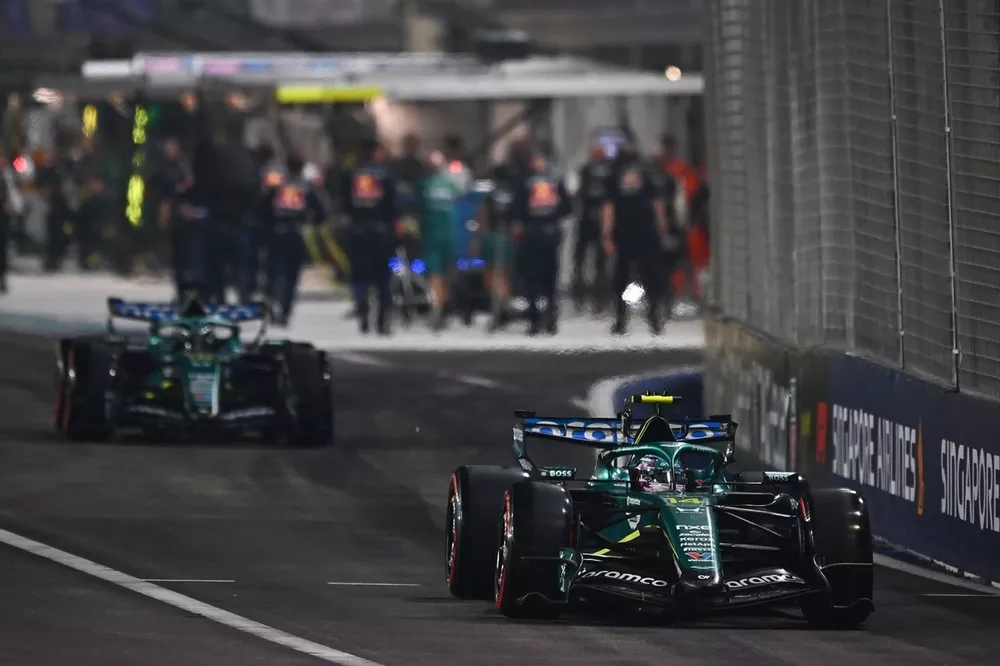
Honda’s second 2026 power unit upgrade fails to eradicate turbo lag, with the issue resurfacing at the Singapore Grand Prix and hampering Aston Martin’s AMR26.
The problem hits driveability on energy‑demanding laps, where immediate throttle response matters. A promising build‑up after Malaysia turns into a subdued Marina Bay weekend.

Fernando Alonso reports delayed power delivery exiting low‑speed corners. Honda responds by recalling engineers and power units to Sakura for inspection.
Checks reveal no hardware defects. The challenge centers on managing the transient response as the turbocharger spools, creating hesitation between throttle input and delivered boost.
No hardware fault found; Honda shifts focus to software and control settings.
That is galling after Madrid, where Honda spent an ADUO token on a new turbo, following its earlier ADUO upgrade path, both intended to trim lag.
Trackside chief Shintaro Orihara explains Singapore’s stop‑start layout and high energy demands magnify control difficulties, producing unstable acceleration that dents driver confidence and consistency.
The MGU‑K cushions some of the deficit by deploying energy, but limited harvesting at Marina Bay means the system cannot sustain the required operating state across laps.
Limited MGU‑K harvesting at Marina Bay prevents sustained deployment to mask lag.
Under 2026 rules without the MGU‑H, turbo control relies more heavily on software, energy management, and combustion mapping, increasing sensitivity to circuit energy profiles.
Honda therefore pivots to software countermeasures rather than fresh hardware, targeting calibration, torque shaping, and deployment logic. Effectiveness will be proven only in upcoming events.
Aston Martin also confronts a human factor. Team principal Mike Krack accepts expectations inflated after Malaysia, while simulations underplayed real‑world driveability losses from lag.
The team treats Singapore as a reset. It seeks better risk framing for energy‑rich venues and clearer preparation for Austin’s similar demands and long traction phases.
The context matters competitively. Rivals pressing ahead on control software and deployment strategies can gain ground quickly, as highlighted by recent Honda development insights.
There is recent driver‑side evidence too. Earlier concerns around Alonso’s power delivery have been discussed in separate analysis, underlining the recurring nature of the challenge.
Singapore’s energy profile exposes turbo lag despite a new turbo introduced in Madrid under an ADUO token.
Honda’s priority is stabilising throttle response, restoring driver trust, and safeguarding race‑stint consistency. Aston Martin expects incremental gains as software maps iterate through forthcoming weekends.
Visual Summary
TURBO LAG
Honda’s Power Boost Fizzles
Turbo lag stalls Aston Martin’s Singapore charge
Aston Martin AMR26
lost acceleration confidence
at Singapore
lost acceleration confidence
at Singapore
!
Key Lesson:
Key Lesson:
High hopes after Malaysia snapped
by turbo lag’s unpredictable return.
Tech fixes can’t always beat track reality.
Team & drivers felt the emotional impact.
by turbo lag’s unpredictable return.
Tech fixes can’t always beat track reality.
Team & drivers felt the emotional impact.
2nd
Upgrade, but no gain
Upgrade, but no gain
0
Hardware failures found
Hardware failures found
Critical
Turbo lag return
Turbo lag return
Honda’s hope: Software tweaks for Austin
“Simulations can’t capture the shock of hitting turbo lag mid-corner. Singapore taught us the cost of hope and the need for precision.”
– Mike Krack, Aston Martin Team Chief

Daniel Miller reports on Formula 1 Grand Prix weekends with race-day analysis, team-radio highlights, and point-standings updates. He explains power-unit upgrades, aerodynamic developments, and driver rivalries in straightforward, SEO-friendly language for a global F1 audience.