
https://shop.fervogear.com/cart

F1 Drivers Challenged by Max Verstappen: ‘Just Turn Off the Cameras Now’

Highlights
- Verstappen raced 100 participants in a unique karting challenge.
- He started 101st and reached front in just 14 laps.
- Montoya praised the event as a fun, skill-testing concept.
- Proposal for private F1 grid kart race to reduce pressure.
- Verstappen hinted at possibly extending challenge to 200 participants.
- Such events could improve drivers’ skills and foster camaraderie.
Juan Pablo Montoya urges current F1 drivers to replicate Max Verstappen’s off‑camera karting challenge, after the Red Bull driver’s headline event near Silverstone last week.
Verstappen started 101st against a 100-strong field of creators and media, with 30 laps to reach the front. He did so in 14 laps, completing the run in 35 minutes.

The exercise stresses traffic management, risk control, and spatial awareness in a mixed-ability pack. It rewards precision and patience as much as outright pace, mirroring core racecraft demands.
Verstappen climbed from P101 to the front in just 14 laps against 100 rivals.
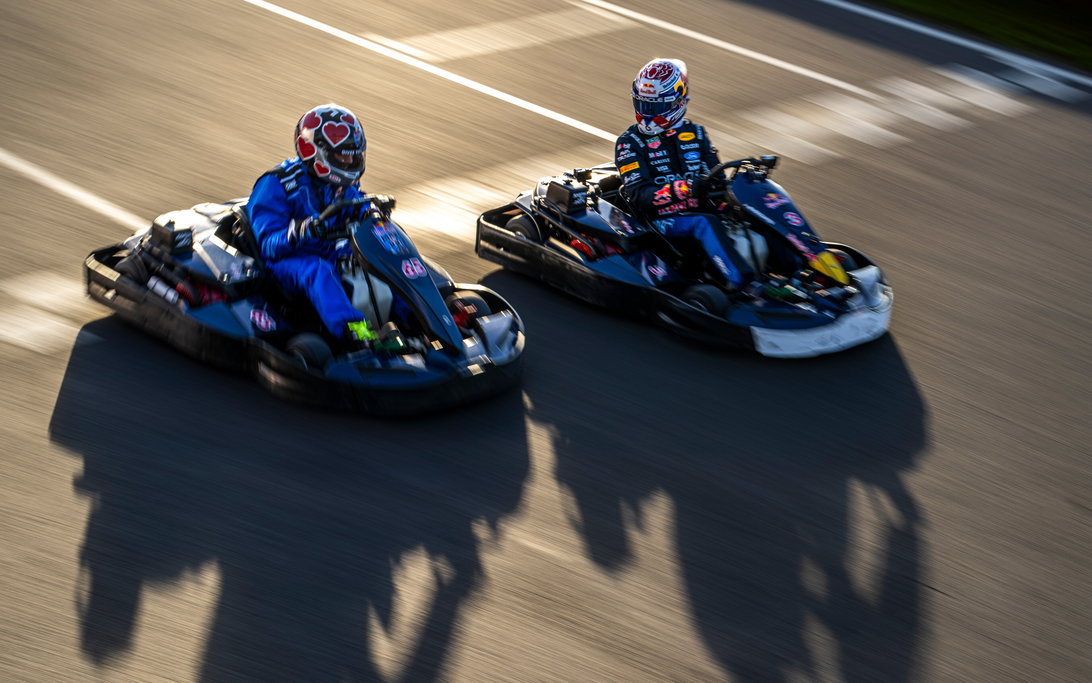
Montoya describes the event as “really cool,” aligning it with Red Bull’s long-running back-to-front challenges across varied environments. The aim is to probe decision-making under persistent traffic pressure.
He highlights the need to be assertive without forcing rivals off track. That balance echoes modern F1 racing standards and the consequences of misjudged wheel-to-wheel choices.
Montoya proposes a private, camera‑free kart race for the entire F1 grid using identical rental karts.
His proposal is simple: supply identical rental karts to the full grid, turn off the cameras, and let competitive instincts breathe without reputational or political baggage.
Such running would sharpen race starts, pack navigation, and safety car restarts. The relevance increases amid scrutiny of Verstappen’s form and a closely watched winless 2026 run.
The off-track exercise also dovetails with Verstappen’s recent adaptability under adversity, including widely discussed car issues that demand measured decision-making at high speed.
Verstappen has hinted at scaling the format to “Max vs 200,” underscoring appetite for tougher benchmarks.
Verstappen’s floated “Max vs 200” escalation underscores the format’s appeal. Increased density amplifies decision load, testing anticipation, positioning, and mechanical sympathy in extended traffic.
Privacy is a key variable. Removing cameras lowers external pressure, encouraging natural competition and candid debriefs, away from narratives about being overlooked in F1 or perceived image management.
There are practicalities. Teams must weigh safety, parity of equipment, and insurance, while preserving camaraderie benefits. Transparent rules and marshal coverage would mirror best-practice karting protocols.
As F1’s calendar intensifies, low-stakes, high-rep racecraft work can complement simulator mileage. It reinforces fundamentals and reconnects drivers with the essential joy of competition.
Visual Summary
MAX VS 100: Kart Chaos Mastered
Started 101st. P1 in 14 laps.
Survived the swarm, conquered the chaos.
Survived the swarm, conquered the chaos.
35 min
Elapsed time
14 laps
To reach the front
💨 Precision, patience, traffic
❝
Really cool event—drivers with skill and restraint, threading through the chaos.
No pushing, just mastery.
— Juan Pablo Montoya
Really cool event—drivers with skill and restraint, threading through the chaos.
No pushing, just mastery.
— Juan Pablo Montoya
Max’s next challenge?
Max vs 200 — bring it on!
Max vs 200 — bring it on!
🔑
Montoya’s vision: All F1 drivers, no cameras. Fun, freedom, real competition.
Montoya’s vision: All F1 drivers, no cameras. Fun, freedom, real competition.
- No pressure
- Just pure racing
- Stronger bonds
More than speed:
Races like these reveal character, skill, and pure joy.
Races like these reveal character, skill, and pure joy.
Daniel Miller reports on Formula 1 Grand Prix weekends with race-day analysis, team-radio highlights, and point-standings updates. He explains power-unit upgrades, aerodynamic developments, and driver rivalries in straightforward, SEO-friendly language for a global F1 audience.