

https://shop.fervogear.com/cart

Mercedes Claims Record as Most Successful F1 Manufacturer Ever

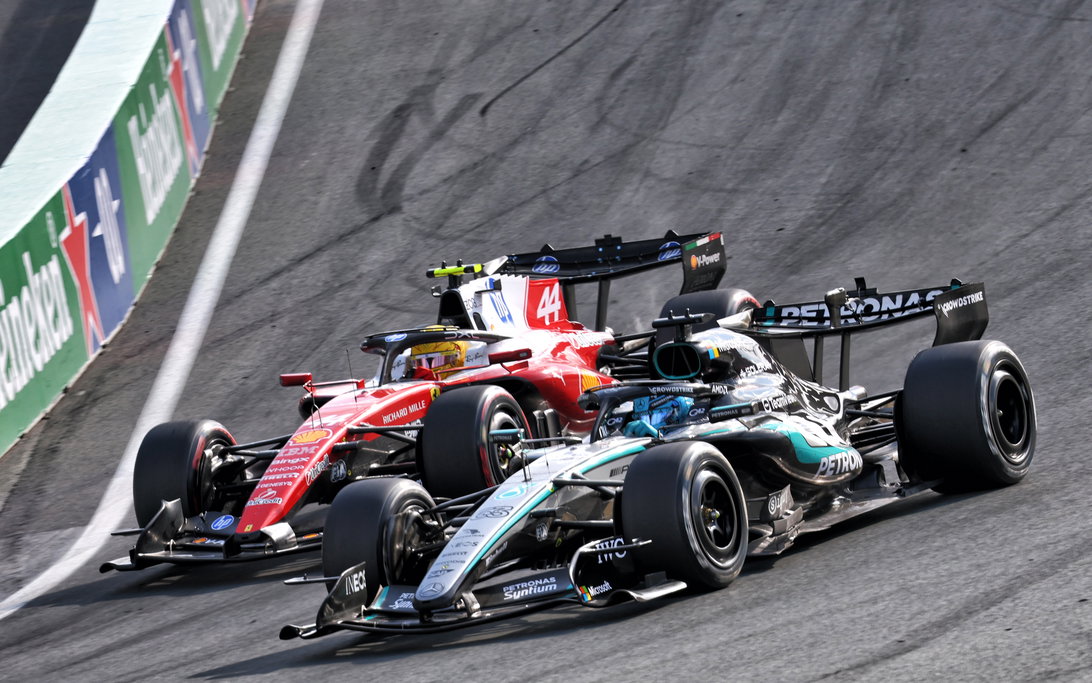
Highlights
- Mercedes surpassed Ferrari with 252 Formula 1 engine wins.
- George Russell’s Azerbaijan GP victory secured Mercedes’ milestone.
- Ferrari led for 22 years with 251 wins before being overtaken.
- Mercedes engines dominated turbo hybrid era with 153 wins since 2014.
- Mercedes-powered cars won with multiple teams, Ferrari mostly with themselves.
- Ford Cosworth ranks third with 179 wins in engine manufacturers list.
Mercedes becomes Formula 1’s most successful engine supplier after George Russell’s win in Baku delivered a 252nd victory for Mercedes power.
The milestone ends Ferrari’s 22-year tenure at the top, with the Scuderia on 251 wins after Charles Leclerc’s recent success at Silverstone.

Russell’s result at the Azerbaijan Grand Prix underlines how decisively the turbo-hybrid era has tilted the balance toward Mercedes.
Mercedes’ Grand Prix journey starts in 1954, when Juan Manuel Fangio wins the French Grand Prix on debut with the marque.
Nine victories follow before a 1955 withdrawal in the wake of the Le Mans disaster stalls the program for decades.
The return gathers momentum in the late 1990s through Ilmor-Mercedes, with David Coulthard delivering win number 10 at the 1997 Australian Grand Prix.
Mercedes leads the all-time F1 engine wins list with 252 after Russell’s Baku victory.
By then, Ferrari already holds 108 victories, despite inconsistency in the early and mid-1990s.
Ferrari moves past Ford Cosworth at the 2004 British Grand Prix, courtesy of Michael Schumacher, and builds that tally to 251.
Leclerc’s latest win adds to that number, though Mercedes closes rapidly across the hybrid period.
Since 2014, Mercedes-powered cars have 153 wins; Ferrari-powered entries have 29.
The spread of Mercedes victories is notable. Success spans the works team, McLaren, Brawn GP, and Racing Point, reflecting depth in integration and deployment.
Ferrari’s wins are overwhelmingly with the works outfit. The exception is Sebastian Vettel’s 2008 Monza triumph for Toro Rosso.
Ferrari’s 251 wins are almost entirely with the works team; Toro Rosso’s 2008 Monza win is the lone customer exception.
The historical leaderboard now reads Mercedes 252, Ferrari 251, Ford Cosworth 179, Renault 169, and Honda 89.
Names such as Coventry Climax, Honda RBPT, TAG Porsche, BMW, and BRM also feature, with varied eras of influence.
Competitive context matters. The 2014 ruleset accelerates Mercedes’ rise, pairing efficient combustion with class-leading hybrid deployment.
The next reset arrives in 2026, with revised power units and sustainable fuels likely reshaping the competitive map.
Ferrari’s ambitions remain clear, as outlined by the Ferrari F1 chief, who targets a power unit upswing to retake momentum.
Mercedes, meanwhile, frames the milestone within broader rivalries and strategic battles that will intensify under the new rules.
Recent form sets a compelling narrative, with Charles Leclerc anchoring Ferrari’s charge while Mercedes refines its package.
The numbers show past dominance. The next regulation cycle will decide whose power shapes the future.
Visual Summary
Mercedes
Rises Above All
Rises Above All
With 252 wins, Mercedes has overtaken Ferrari as the most successful engine builder in F1 history.
Ferrari’s 22-year run ends—just one win short at 251.
Ferrari’s 22-year run ends—just one win short at 251.
153
Hybrid era wins
Hybrid era wins
22
Years Ferrari led
Years Ferrari led
4
Teams powered by Mercedes
Teams powered by Mercedes
“From Fangio to Russell, engineering mastery
has rewritten the Formula 1 record books.”

Daniel Miller reports on Formula 1 Grand Prix weekends with race-day analysis, team-radio highlights, and point-standings updates. He explains power-unit upgrades, aerodynamic developments, and driver rivalries in straightforward, SEO-friendly language for a global F1 audience.