

https://shop.fervogear.com/cart


The Key Hidden Factor Driving Red Bull’s F1 Breakthrough

Highlights
- Red Bull’s improved straightline speed key to recent successes.
- Engine upgrades restricted by FIA’s ADUO rules this season.
- Laurent Mekies highlighted ongoing development despite hardware limits.
- Malaysia win showcased RB22’s adaptability in challenging conditions.
- Red Bull pushing for ADUO rule changes for next season.
- Team continues refining aero and power unit integration.
Max Verstappen’s Bahrain Grand Prix win spotlights Red Bull’s progress, but the decisive development is improved straightline speed, highlighted by Malaysian Grand Prix qualifying against Ferrari and Mercedes.
While the Baku aerodynamic package drew headlines, data indicates the power unit’s contribution has grown within FIA limits, with Sepang speed figures placing Red Bull consistently near the competitive benchmark.

Speed traps showed Bottas at 329.5km/h, while Verstappen reached 310.7km/h at reference points. Not always top, the package remains efficient given development restrictions and set-up trade-offs.
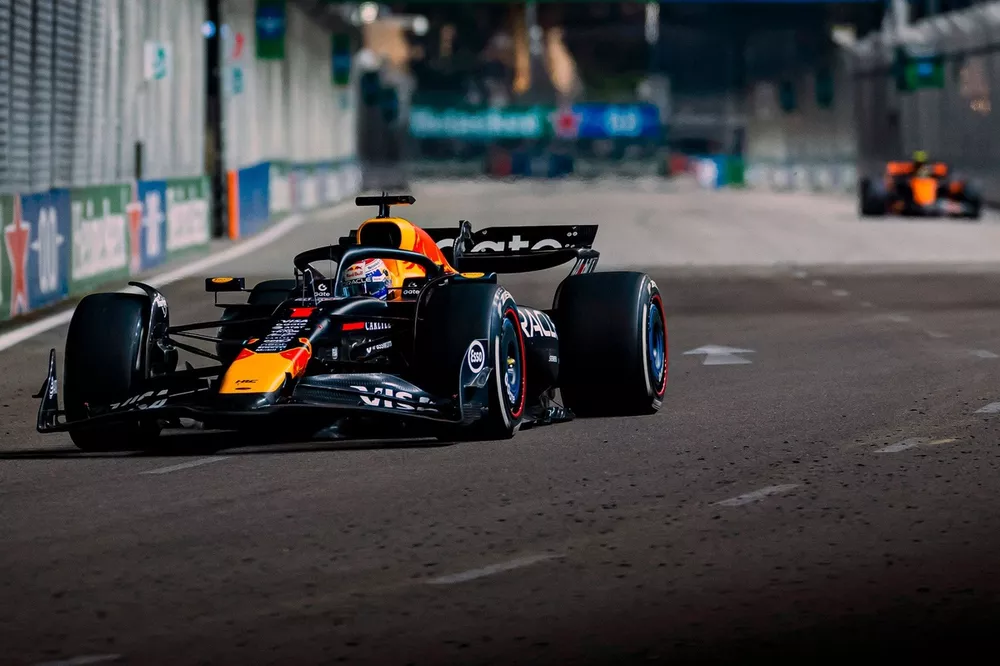
The ADUO framework restricts new engine hardware, yet Red Bull and Ford found gains through calibration, deployment strategy, drivability, and start performance without infringing the homologation freeze.
Team principal Laurent Mekies acknowledged frustration at the FIA’s stance, but praised Milton Keynes engineers for broadening operating windows and extracting incremental lap time under tight constraints.
“We improved where we could — drivability, deployment, and launches — despite hardware limits,” Laurent Mekies noted.
Pre-season, Toto Wolff labelled Red Bull’s energy deployment a benchmark, even as Mercedes appeared to hold the most rounded power unit. Since then, Red Bull has methodically reduced that margin.
Current regulations reward deep chassis–engine integration. That synergy underpinned wins in Baku and Malaysia, shifting focus from peak numbers to consistent performance across varied tracks and conditions.
The much-discussed Baku upgrade was a measured step, closing an early near one-second deficit. Crucially, it formed part of a broader, parallel development of chassis and power unit integration.
Malaysia highlighted the RB22’s adaptability in extreme heat and over a rough surface, reinforcing recent gains beyond pure peak power.
Rivals will respond with updates, and fluctuations underline a tight competitive spread. The ongoing threat from rivals remains real, especially at venues rewarding medium‑ and high‑speed performance.
Whether Malaysia signals genuine parity with Mercedes or reflects surface and temperature effects remains open. Mekies cautioned that heat and roughness likely reshuffled order, but preparation principles stay unchanged.
Red Bull is lobbying for ADUO rule refinements for next season to align evaluation methods and development freedoms.
Aero degradation that blunted early form persists. The team continues to stabilise the platform and broaden set-up ranges to suit differing layouts, without sacrificing tyre management or deployment efficiency.
Within the ADUO rules context, Mekies said Red Bull was surprised by FIA evaluations and is engaging to refine assessment methods and allowances for next season.
For now, focus stays on extracting performance from the existing package. Integrated design and steady iteration continue to pay off, aligned with Red Bull’s next F1 goal.
Visual Summary
Bahrain
Baku
Sepang
Red Bull’s Rising Pace
310.7 km/h
Max Verstappen’s top qualifying speed at Sepang
Max Verstappen’s top qualifying speed at Sepang
🏁 Malaysia GP WIN — Powered by improved engine driveability, despite strict rules on upgrades.
🛠 ADUO Rules
No hardware engine upgrades allowed, but Red Bull still found extra speed.
No hardware engine upgrades allowed, but Red Bull still found extra speed.
⚡ Synergy
Chassis + engine integration made the difference at mixed tracks like Sepang.
Chassis + engine integration made the difference at mixed tracks like Sepang.
Challenge continues—Rivals close the gap; Red Bull aims for more with future upgrades.

Daniel Miller reports on Formula 1 Grand Prix weekends with race-day analysis, team-radio highlights, and point-standings updates. He explains power-unit upgrades, aerodynamic developments, and driver rivalries in straightforward, SEO-friendly language for a global F1 audience.